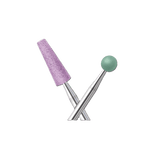
Dental Lab Abrasives for Hard Metal Alloys by Busch
Dental Lab Abrasives for Hard Metal Alloys by Busch are precision-engineered tools designed to meet the demanding requirements of professional dental laboratory technicians. When working with hard metal alloys, the right abrasive makes a critical difference in achieving consistent surface finishes, accurate contours, and efficient material removal.


Busch & Co. GmbH
Busch Aluminum Oxide Cylinder Flat Abrasive | Busch No. B 732 050 – Blue – HP | Pack of 6
Regular price $22.99Unit price-
Busch & Co. GmbH
Busch Aluminum Oxide Bud Round Abrasive | Busch No. B 671 050 – Blue – HP | Pack of 6
Regular price $22.99Unit price -
Busch & Co. GmbH
Busch Aluminum Oxide Taper (Cone) Round Abrasive | Busch No. B 652R 033 – Blue – HP | Pack of 6
Regular price $22.99Unit price -
Busch & Co. GmbH
Busch Aluminum Oxide Taper (Cone) Round Abrasive | Busch No. B 649R 025 – Blue – HP | Pack of 6
Regular price $22.99Unit price -
Busch & Co. GmbH
Busch Aluminum Oxide Round Abrasive | Busch No. B 601 030 – Blue – HP | Pack of 6
Regular price $22.99Unit price


Reference pages already linked from this collection, in one place.
Which Hard Metal Alloy Abrasive Do You Need?
All five abrasives are blue, medium-grit aluminum oxide (alox) HP abrasives; choose the head shape first, then the size (last three digits of the Busch number). Every active product in the collection is linked once below.
Blue aluminum oxide abrasives, medium grit (HP)5 items
| Busch No. | Pattern or size |
|---|---|
| B 601 030 | round · size 030 · blue · medium grit · HP · pack of 6 |
| B 649R 025 | taper (cone) round · size 025 · blue · medium grit · HP · pack of 6 |
| B 652R 033 | taper (cone) round · size 033 · blue · medium grit · HP · pack of 6 |
| B 671 050 | bud round · size 050 · blue · medium grit · HP · pack of 6 |
| B 732 050 | cylinder flat · size 050 · blue · medium grit · HP · pack of 6 |
Why Choose Busch Abrasives for Hard Metal Alloys?
Busch has a long-standing reputation in the dental industry for manufacturing high-quality rotary instruments and abrasives. Their range of Dental Lab Abrasives for Hard Metal Alloys is formulated specifically to handle the hardness and toughness of cobalt-chromium, nickel-chromium, and other hard metal alloy frameworks commonly used in crown, bridge, and partial denture fabrication.
- Consistent cutting performance: Engineered abrasive grains maintain sharpness throughout the working cycle for reliable, repeatable results.
- Precise material removal: Designed to reduce material without generating excessive heat that could compromise alloy structure.
- Versatile applications: Suitable for grinding, finishing, and polishing hard metal alloy restorations at various stages of laboratory workflow.
- Professional-grade durability: Built to withstand the rigors of straight laboratory handpieces and motors (HP shank).
Applications in the Dental Laboratory
Using the correct Dental Lab Abrasives for Hard Metal Alloys is essential during framework adjustment, occlusal refinement, and surface preparation prior to veneering or coating. Busch abrasives support technicians in delivering well-finished restorations that meet clinical specifications.
Clinical Use
These blue aluminum oxide abrasives are dental laboratory instruments for the straight handpiece. Busch specifies them for semi-precious and non-precious metal alloys, where they are used for framework adjustment, occlusal refinement and surface preparation before veneering or coating.
Care and Reconditioning
Clean, disinfect and sterilize the instruments between uses following the manufacturer instructions and the symbols on each package, and replace an instrument once it is worn, out of round or no longer cuts evenly. Our Dental Bur Reprocessing & Sterilization Guide covers the workflow for Busch rotary instruments; maximum speeds are in the Dental Bur Speed Chart.
Compare With
Related Busch collections: Abrasives for Medium Hard Metal Alloys, Abrasives for Ceramics, Acrylics & Metal Alloys, Dental Lab Abrasive Discs, Stones & Wheels, Dental Lab Burs for Metal Alloy Technology, 2 Step Laboratory Polishers for Metal Alloys, and Fiber Cutting Off Discs. For speeds and terminology, see the Dental Bur Speed Chart and the Dental Bur Glossary.

FAQ
What types of hard metal alloys are these abrasives suitable for?
Busch Dental Lab Abrasives for Hard Metal Alloys are suitable for cobalt-chromium, nickel-chromium, and similar hard metal dental alloys commonly used in prosthetic frameworks.
Are these abrasives compatible with standard dental laboratory handpieces?
Yes, Busch abrasives are designed for use with standard dental laboratory straight handpieces and motors (HP shank) operating at recommended RPM ranges.
How should these abrasives be stored?
Store in a dry, clean environment away from moisture and contaminants to maintain optimal cutting performance and longevity.