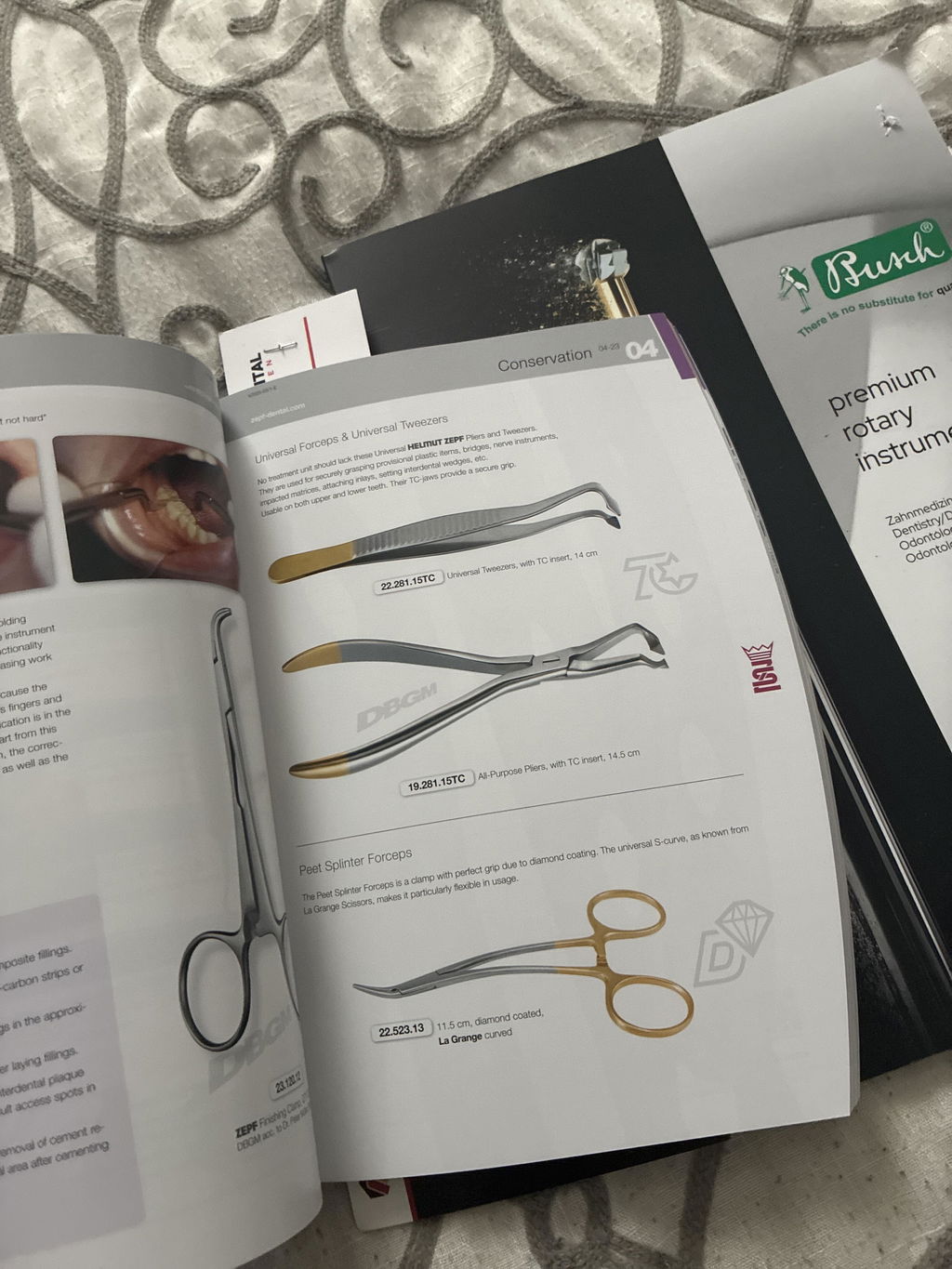
Dental Spoon Excavator Sizes & Restorative Hand Instrument Guide
The spoon excavator is the defining hand instrument of caries removal — a sharpened, spoon-shaped blade that lifts softened dentin the way a bur cannot: with tactile feedback that tells you exactly when you've reached sound tooth structure. This guide maps the Helmut Zepf excavator range by figure number and working diameter, then covers the condensers, pluggers, and burnisher instruments that complete the restorative hand instrument setup.
Revised on September 30, 2026
Why Hand Excavation Still Matters
A rotary bur removes whatever it touches; a sharp spoon removes only what yields. Carious dentin peels away under a controlled stroke while sound dentin resists, which gives a tactile endpoint no handpiece provides. That is why selective caries removal pairs rotary access and gross reduction with hand excavation in the two critical zones: the pulpal floor, where over-preparation risks exposure, and the peripheral seal zone, where removal must be complete.
Spoon Excavator Size Chart
Excavators are specified by figure number and working-end diameter. Smaller diameters reach conservative preparations and pulpal-floor detail work; larger diameters clear bulk caries efficiently. All patterns below are double-ended (mirrored left/right working ends) in German surgical stainless steel.
| Pattern | Figure Numbers | Working Diameter | Best For |
|---|---|---|---|
| Standard spoon (24.708 series) | #125/126, #127/128, #129/130, #131/132 | Ø 2.5 / 2.0 / 1.7 / 1.0 mm | General caries excavation across cavity sizes |
| Standard spoon (24.709 series) | #135/136, #139/140, #141/142, #145/146 | Ø 2.5 / 1.7 / 1.4 / 1.0 mm | Alternate shank pattern for varied access angles |
| Gillet spoon | #243, #244, #245 | Ø 1.0 / 1.4 / 2.0 mm | Gillet blade profile for deep and proximal excavation |
| White spoon | #18, #19, #20 | 1.5 / 2.0 / 2.5 mm | The classic American White pattern spoon shape |
A practical pairing covers three diameters — e.g. 1.0 mm for conservative access, 1.7 mm as the daily driver, 2.5 mm for bulk removal. Browse the full Spoon Excavator Collection.
Size-by-Size Picks
Start with the largest diameter that still fits the lesion comfortably, then switch to a smaller end to refine walls and margins. Posterior occlusal and interproximal lesions usually call for 2.0–2.5 mm; anterior and pediatric cavities are usually better served by 1.0–1.7 mm.
- Bulk removal: Spoon Excavator #125/126, Ø 2.5 mm (No. 24.708.25).
- Fine work near the pulp or in narrow fissures: Spoon Excavator #131/132, Ø 1.0 mm (No. 24.708.31).
- Interproximal and cervical access: Gillet Spoon Excavator #245, Ø 2.0 mm (No. 24.711.45).
- Open cavities with a wider spoon face: White Spoon Excavator #19, 2.0 mm (No. 24.733.19).
Technique: Getting the Endpoint Right
- Work from the periphery inward. Clear the dentino-enamel junction to hard dentin first, because the seal zone tolerates no residual caries, then approach the pulpal aspect conservatively.
- Shave, don't scoop. Use short, overlapping strokes with the blade edge and let sharpness do the work.
- Trust the tactile endpoint. Over the pulp, leathery but firm dentin can stay in selective removal protocols; continuing to hard dentin there risks exposure without improving outcomes.
- Match spoon to cavity. An oversized spoon can't follow the floor of a small preparation, and an undersized one turns bulk removal into dozens of strokes.
Completing the Restorative Setup: Condensers, Pluggers & Filling Instruments
Once the preparation is clean, placement instruments take over. Condensers pack restorative material into the preparation — the Zepf axial condensers (#35 at 1.0/1.2 mm, #36 at 1.2/1.6 mm, #37 at 1.6/2.0 mm) step up in diameter as the increment grows, and the amalgam technique of condensing in overlapping strokes applies equally to bulk-fill composite. Pear-shaped and ball-shaped pluggers adapt material to internal line angles, and the NANOPAL-coated composite filling instruments combine spatula, plugger, condenser, and burnisher ends on non-stick working surfaces for layering and pre-polymerization contouring — the CompoSMOOTH line extends this for final surface shaping. For Class II work, the matrix side of the setup is covered in the Tofflemire Collection.
Dental Burnishers
A burnisher smooths and adapts restorative material — burnishing the matrix band against the adjacent tooth before placement, adapting margins, and pre-polishing surfaces after carving. In the Zepf conservation line, burnisher working ends come combined with spatulas and pluggers on double-ended NANOPAL-coated instruments: the spatula / 2.6 mm beavertail burnisher for broad surface adaptation, and pear-shaped burnisher combinations at Ø 1.5 mm and Ø 1.9 mm for occlusal anatomy and margin work. Ball-pattern smoothing tasks are covered by the ball-shaped plugger collection. Dedicated standalone burnisher figures from the Zepf catalog are being added to our US assortment — call our experts for availability.
Before the Hand Instruments: Rotary Excavation
Spoon excavation typically follows rotary access and gross removal — see Cavity Preparation Burs and the polymer-safe Busch 1SX Excavating Bur, designed to remove carious dentin while sparing sound structure — the rotary counterpart to the spoon's selective-removal philosophy.
Care and Sterilization
Excavator blades are cutting edges: sharpen them like curettes, protect the spoon rims from contact damage in cassettes, and retire instruments with rolled or chipped edges — a dull spoon crushes dentin instead of shaving it, destroying the tactile endpoint that makes hand excavation valuable. Reprocessing parameters are in the Instrument Reprocessing & Sterilization Guide; maintain edges between services with sharpening accessories, and our factory-certified sharpening service restores original blade geometry.
Frequently Asked Questions
What is a spoon excavator used for?
Removing soft, carious dentin by hand. The sharpened spoon-shaped blade shaves softened tissue while transmitting tactile feedback, letting the clinician stop at sound dentin — central to minimally invasive and selective caries removal techniques.
What do the numbers on an excavator mean?
Paired figure numbers (e.g. #127/128) identify the double-ended pattern — mirrored left and right working ends on one handle — and each pattern is made in several working diameters, typically 1.0 to 2.5 mm.
What size spoon excavator should I use?
Match the spoon to the cavity: 1.0 mm for conservative preparations and detail work at the pulpal floor, 1.5–2.0 mm for routine excavation, 2.5 mm for bulk removal in large open lesions.
What is the difference between a spoon excavator and a curette?
Both have rounded blades, but a spoon excavator is a restorative instrument sharpened for shaving carious dentin inside a cavity preparation, while a periodontal curette is designed for removing calculus from root surfaces. They are not interchangeable.
Can caries be removed with hand instruments alone?
In accessible lesions, yes: the atraumatic restorative technique (ART) relies entirely on hand excavation. In routine practice, rotary access plus hand excavation at the critical zones combines efficiency with control.
How often should spoon excavators be sharpened?
Whenever soft dentin smears rather than peels. In a busy practice that means routine edge maintenance, not an annual job.
Are Gillet and White pattern excavators interchangeable with standard spoons?
They overlap, but blade curvature and width differ: Gillet blades suit interproximal and cervical access, while White blades suit broader open-cavity removal.
What is a dental burnisher used for?
Smoothing and adapting restorative material — burnishing matrix bands against adjacent teeth for tight contacts, adapting restoration margins, and pre-polishing surfaces. Common patterns include ball, egg (football), and beavertail working ends.
Are spoon excavators single or double ended?
Nearly always double-ended, with mirrored left/right blades so one instrument works both walls of the preparation without repositioning the hand.
Part of our Restorative, Prosthetic & Diagnostic Instruments hub.