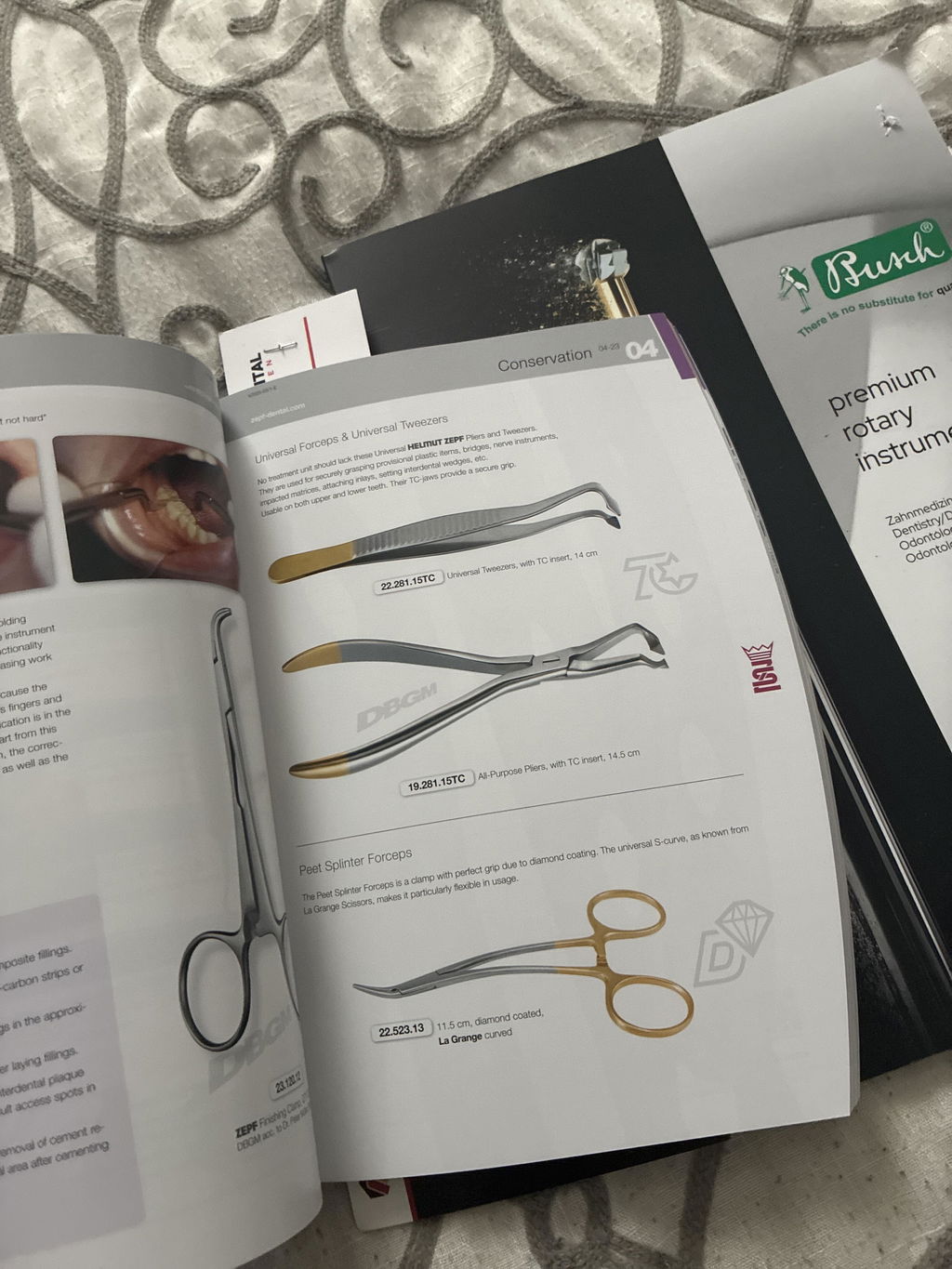
Restorative Instrument Glossary
Plain-language definitions for the hand instruments, matrix components, and terminology of direct and indirect restorative dentistry — with the Helmut Zepf reference series where we stock the instrument. Companion glossaries cover surgical, hygiene, and orthodontic instruments.
Revised on October 1, 2026
What Are Restorative Instruments in Dentistry?
Restorative instruments in dentistry are the hand instruments used to place, shape, and finish direct fillings and to prepare teeth for indirect restorations such as crowns and inlays. The main families are excavators for removing decayed dentin, pluggers and condensers for packing material into the preparation, carvers, spatulas, and burnishers for shaping and smoothing it, and the matrix retainers, bands, and wedges that rebuild a missing proximal wall while the material sets. Most are double-ended, pairing complementary working ends on one handle. The glossary below defines each term and notes the Helmut Zepf series where DeutscheDT.com stocks the instrument.
A – C
Articulating paper forceps — Locking tweezers that hold marking paper flat while the patient taps occlusion; the bent Miller pattern is the clinic standard.
Ball-shaped plugger — Composite plugger with a smooth spherical tip for adapting increments and pre-forming fissure anatomy.
bIONIK handle — Zepf’s ergonomic color-coded handle system used across the conservation and hygiene lines.
Burnisher — Smooth egg-, ball-, or beavertail-tipped instrument for adapting margins, smoothing material, and burnishing matrix bands against the adjacent tooth.
Carver — Bladed instrument for cutting anatomy into uncured composite or fresh amalgam; the ATTIN Compo Knife (24.710) is Zepf’s composite carver.
Cement spatula — Flexible flat blade (Zepf 26.130 series) for mixing and loading cements and liners.
Class II restoration — A filling involving the proximal surface of a posterior tooth; the case that demands matrices, wedges, and contact formers.
CompoSMOOTH — Zepf’s modeling system (19.202.00, developed with Prof. Dr. Krastl) with interchangeable silicone tips for non-stick surface shaping before curing.
Condenser — Flat- or segmented-faced instrument for packing restorative or augmentation material; Zepf’s 24.532.19 carries a titanium working end.
Contact point — The area where adjacent teeth touch; restoring it tightly prevents food impaction and drift.
D – M
EASY CONTACT POINT — Zepf’s contact-forming program: 26.123 hand instruments (one contact at a time) and 26.122 MOD pliers (both contacts in one step), pressing the matrix against the neighboring tooth during light-curing.
Excavator (spoon) — Sharp-rimmed spoon for removing carious dentin and temporary cement; sized by blade diameter. See our Spoon Excavator Guide.
Filling instrument — Umbrella term for placement instruments — spatulas, pluggers, and combination double-ended patterns.
Finishing strip — Abrasive plastic or metal strip drawn through the embrasure to contour and polish the proximal surface; held under tension with StripGrip tweezers (22.998.14).
Interproximal — Between adjacent teeth; the region shaped by matrix, wedge, and strip.
Matrix band — Thin stainless or polyester band that replaces a missing cavity wall during placement; circumferential (Tofflemire) or sectional pre-contoured.
Matrix retainer — The device tensioning a circumferential band; the Tofflemire (universal) retainer is the standard pattern.
MOD — Mesial-occlusal-distal: a restoration involving both proximal surfaces plus the occlusal table.
N – S
NANOPAL — Zepf’s ultrahard (≈4,500 Vickers) working-end coating; non-stick and highly scratch-resistant.
Onyx coating — Zepf’s hard, non-reflective black working-end finish used across the composite line.
Pear-shaped plugger — Composite plugger with a smooth pear tip for adapting material into line angles without pull-back.
Plugger — Any smooth-tipped instrument that presses material into the preparation; see ball- and pear-shaped patterns.
Retraction-thread plugger — Serrated-pad instrument (Zepf 24.548.01) for placing retraction cord into the sulcus before impressions and cervical restorations.
Rubber dam forceps — Instrument that spreads the dam clamp for placement and removal.
Sectional matrix — Small pre-contoured band held by a separating ring; the modern standard for single-box Class II composites.
Spatula (composite) — Thin flat blade for carrying, layering, and shaping increments; micro versions (26.120.13) serve minimally invasive work.
StripGrip — Zepf’s diamond-coated strip-holding tweezers (22.998.14) that lock finishing strips under tension.
T – Z
Tofflemire — The universal circumferential matrix retainer; bands come in thin (≈0.038 mm) and standard (≈0.05 mm) gauges and #1 / #2 / #13 patterns. See our Matrix Systems & Contact Point Guide.
Wedge — Wooden or plastic interproximal insert that separates teeth slightly and seals the gingival band margin.
Working end — The functional tip of a hand instrument; double-ended patterns pair complementary shapes on one handle.

FAQ
Where can I browse the instruments behind these terms?
Start with the Dental Composite Instrument Collection — every family in this glossary links from there, or call (917) 480-2682 ext 101 for pattern advice.
Is there manufacturer literature for these lines?
Yes — the factory flyers and catalog are collected in our Restorative Instrument Library.
How should these instruments be reprocessed?
Follow our Instrument Reprocessing & Sterilization Guide, which reflects the manufacturer’s validated procedure.
Part of our Restorative, Prosthetic & Diagnostic Instruments hub.