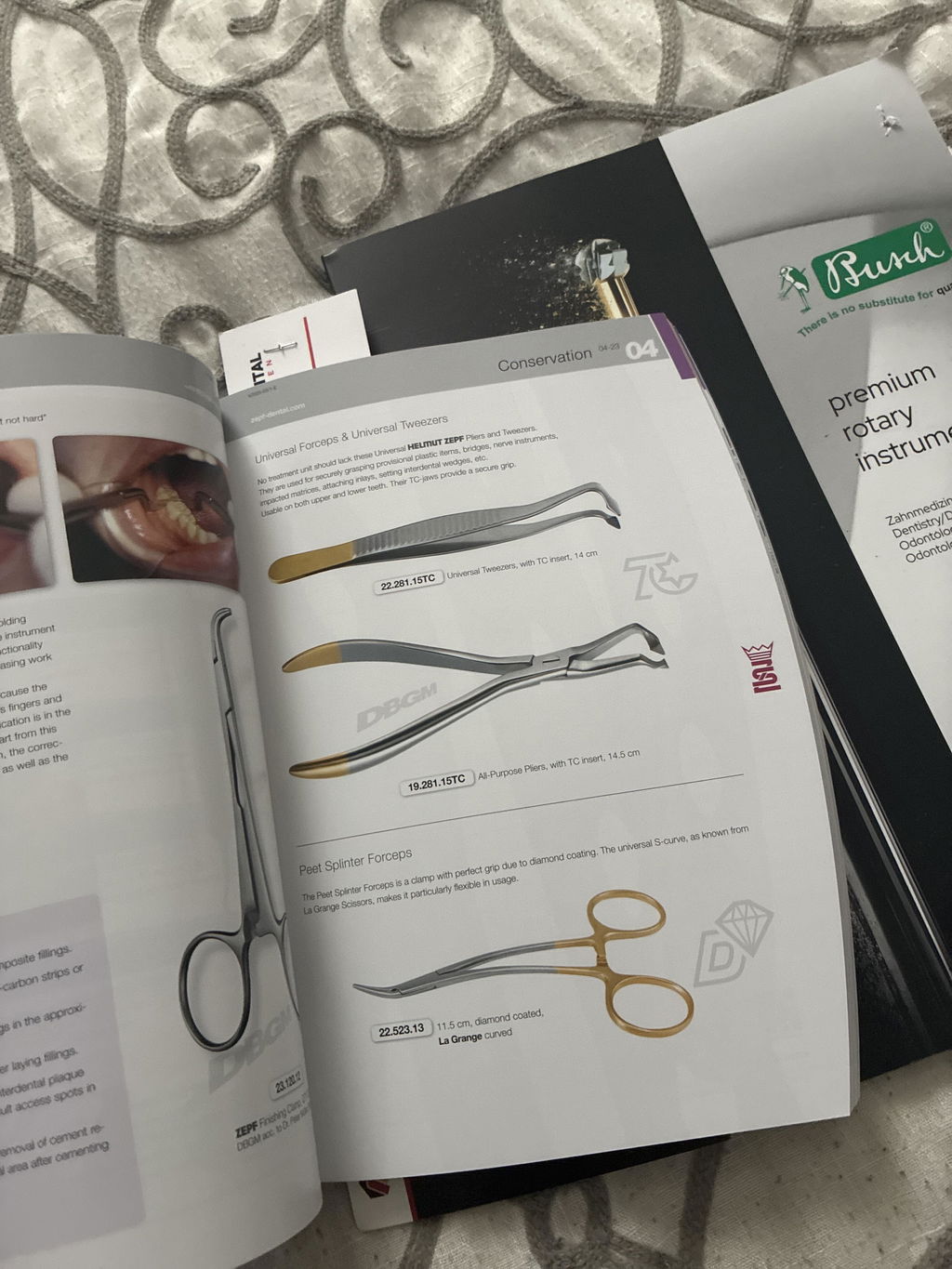
Surgical & Tissue Forceps Identification Guide – Adson, Allis, Kelly, Mosquito & Rongeur Compared
Forceps identification trips up ordering more than any other instrument category: Adson, Allis, Kelly, mosquito, rongeur — the names are eponymous, the patterns overlap, and picking the wrong one means an instrument that crushes tissue it should hold or slips on tissue it should grip. This guide identifies the major surgical and tissue forceps patterns used in dentistry and oral surgery, with a comparison chart, toothed vs. non-toothed guidance, and links to each collection.
Revised on October 1, 2026
Two Families: Thumb Forceps vs. Locking Forceps
All surgical forceps fall into two mechanical families. Thumb forceps (Adson, standard tissue forceps, Semken and Gerald patterns, dressing forceps) are spring-loaded tweezers — grip force comes from your fingers, released the instant you relax. Locking forceps (Allis tissue forceps, Kelly, mosquito, and other hemostats) have ringed handles and a ratchet that clamps and holds without continuous pressure. The Allis is named a tissue forceps, but it is a locking (ratcheted) instrument, not a thumb forceps. Thumb forceps are for handling; locking forceps are for holding.
Surgical Forceps Identification Chart
| Forceps | Family | Identifying Features | Primary Use in Dentistry |
|---|---|---|---|
| Adson | Thumb | Wide grasp platform tapering sharply to a fine tip; toothed (1 x 2) or serrated | Flap stabilization during suturing (toothed); dressing and membrane handling (serrated) |
| Micro Adson | Thumb | Adson profile with finer tip, often fine spring and grip holes; straight or 30° curved, some with tungsten carbide jaws | Periodontal microsurgery, grafting, delicate flap work |
| Tissue forceps (standard) | Thumb | Straight, uniform-width pattern with 1 x 2 teeth at the tip | General soft tissue grasping during surgery and suturing |
| Semken | Thumb | Wider, flatter tip platform than the Adson; 1 x 2 teeth; straight or curved | General soft tissue retraction, flap reflection and grasping |
| Gerald | Thumb | Fine 1 x 2 tip on a longer, slimmer shaft, commonly 7" | Reach and visibility in posterior sites and deeper fields |
| Allis | Locking | Ringed handles, ratchet, angled jaws with interlocking short teeth | Grasping and retracting tougher tissue that must be held firmly |
| Kelly | Locking (hemostat) | Ringed handles, ratchet; transverse serrations on the distal half of the jaw only | Clamping vessels, holding sutures and materials; straight or curved |
| Mosquito (Halsted) | Locking (hemostat) | Smallest hemostat; fine jaws fully serrated to the box lock | Fine vessel clamping, ligature handling, small-field work |
| Rongeur (e.g. Blumenthal) | Spring-handle cutting | Double-spring handles, sharp scoop-shaped cutting jaws | Removing bone spicules, trimming alveolar ridge, root tip access |
| Bone-holding | Locking | Heavy construction, serrated or pointed bone-gripping jaws | Stabilizing bone segments in surgical and CMF procedures |
Toothed vs. Non-Toothed: The Practical Rule
Toothed patterns (1 x 2 teeth) hold slippery soft tissue securely with less squeezing force — counterintuitively, teeth are often less traumatic than the crushing pressure needed to keep smooth jaws from slipping. Use them on tissue and flaps. Non-toothed (serrated) patterns are for anything teeth would perforate: dressings, sutures, membranes, and friable tissue. If it tears, go smooth; if it slips, go toothed.
In the Zepf range, the toothed tissue forceps (tissue forceps with teeth) are the standard tissue forceps, the Semken and the Gerald, plus the toothed Adson and Micro Adson; the non-toothed options are the serrated Adson and Micro Adson dressing patterns. Semken forceps are the choice when you want the widest toothed platform, Gerald when you want the longest reach, Adson when you want the finest tip.
Toothed or non-toothed, pattern by pattern:
- Adson and Micro Adson: both versions exist. Toothed (1 x 2) for tissue; non-toothed (serrated) dressing versions for materials and delicate structures.
- Standard tissue, Semken and Gerald: toothed, 1 x 2 at the tip.
- Allis: toothed, with short interlocking teeth on angled jaws, held by the ratchet.
- Kelly and mosquito: non-toothed. Transverse serrations, on the distal half of the jaw (Kelly) or all the way to the box lock (mosquito).
- Rongeur and bone-holding: neither. Rongeurs have cutting jaws; bone-holding forceps have serrated or pointed bone-gripping jaws.
Semken and Gerald Tissue Forceps
Semken and Gerald forceps are close relatives of the Adson: spring-type thumb forceps with a 1 x 2 tooth tip for a secure, self-centering hold. What separates them is tip width and length. The Semken has a wider, flatter tip platform that spreads pressure over a larger contact area, suited to general retraction, flap reflection and grasping where a firmer purchase matters more than a fine point: Semken, Straight, 5" (22.480.12) and Semken, Curved, 5" (22.481.12). The Gerald keeps a fine 1 x 2 tip close to the Adson on a longer, slimmer shaft, giving reach and visibility in posterior and deeper fields without crowding your hand: Gerald, 7", Straight (22.430.17).
Adson vs. Allis vs. Kelly: The Decision Rule
- Grasp and release constantly (suturing, flap handling): Adson. Toothed for tissue, serrated for materials.
- Need a broader grip or more reach (general flap handling, posterior or deep fields): Semken for the wider tip, Gerald for the 7" shaft.
- Hold tissue continuously (retraction, excision): Allis. The ratchet does the work, but its teeth grip aggressively, so reserve it for tissue being removed or tissue robust enough to tolerate the hold.
- Clamp and leave (vessels, ligatures, sutures, materials): Kelly or mosquito. Curved for tight anatomy; the mosquito is the standard choice for ligature handling in orthodontics.
Most oral surgery setups carry at least one of each family.
Shop by Pattern
Every pattern above is manufactured in Germany by Helmut Zepf in surgical stainless steel — extraction forceps carry our lifetime warranty, and all instruments are built for repeated autoclave cycles:
- Adson & Micro Adson Forceps
- Tissue Forceps and Micro Tissue Forceps
- Allis Tissue Forceps
- Hemostatic Forceps including Kelly patterns and Mosquito Forceps
- Bone Rongeur Forceps and Bone Holding Forceps
- Suture Forceps and Peet Splinter Forceps
- For tooth removal, see the separate Extraction Instrument Collection — extraction forceps (150, 151, cowhorn, Ash patterns) are anatomy-specific and covered in our extraction guides.
Care and Sterilization
Locking forceps should be sterilized with ratchets open on the first click to allow steam penetration at the box lock; thumb forceps should be protected from tip contact in cassettes. Inspect tip alignment and tooth interdigitation during reprocessing — misaligned tips are the most common reason a forceps "stops gripping." Worn teeth and fatigued springs end a grip the same way; when tips wear, our factory-certified repair and reconditioning service restores them. Full parameters are in our Surgical Instrument Reprocessing & Sterilization Guide, and pattern terminology is in the Surgical Instrument Glossary.
Frequently Asked Questions
What is the difference between Adson and Allis forceps?
Adson forceps are spring-type thumb forceps for momentary grasping with finger pressure; Allis forceps are ring-handled locking forceps whose ratchet holds tissue continuously without hand fatigue. Adson for handling during suturing, Allis for sustained retraction.
What is the difference between Kelly and mosquito forceps?
Both are locking hemostats. Kelly forceps are larger with serrations on only the distal half of the jaws; mosquito (Halsted) forceps are smaller and fully serrated to the box lock, suited to finer vessels and tighter fields.
Are hemostats and hemostatic forceps the same thing?
Yes — hemostat is the common shorthand for ring-handled, ratcheted hemostatic forceps such as Kelly, Crile, and mosquito patterns.
Are Adson forceps toothed or non-toothed?
Both exist. Toothed Adsons (1 x 2 teeth) are for grasping tissue; non-toothed (serrated) Adsons are dressing forceps for materials and delicate structures.
What is the difference between Kelly forceps and a hemostat?
Kelly forceps are a type of hemostat. "Hemostat" names the family of ring-handled locking clamps; Kelly, Crile and mosquito are patterns within it, differing mainly in size and serration coverage.
What are 1 x 2 teeth?
A single tooth on one jaw fitting between two teeth on the opposing jaw — the standard toothed configuration on tissue and Adson forceps, giving a secure grip with minimal closing force.
Part of our Oral Surgery Instruments hub.