Dental Matrix Systems & Contact Point Guide
A matrix rebuilds the missing wall of a Class II preparation so composite or amalgam can be condensed against a defined form — and how that band is selected, wedged, and loaded against the neighboring tooth decides whether the finished restoration has a tight, anatomic contact or an open one that traps food. This guide covers the two matrix philosophies — circumferential (Tofflemire) and sectional — plus the contact-forming instruments that finish the job, with the German-made Helmut Zepf instruments we stock for each step.
Circumferential Systems: The Tofflemire Retainer
The Tofflemire (universal) retainer tensions a stainless band in a loop around the entire tooth. The head’s slots face gingivally, the diagonal slot faces distally, and the band loop’s smaller circumference faces gingivally so the loop matches the tooth’s taper. Circumferential matrices remain the workhorse for large MOD and multi-surface restorations, cusp-replacement situations, and amalgam, where a sectional ring cannot brace the box.
Bands come in two common gauges — thin (≈0.038 mm / 0.0015″) for easier interproximal seating and removal, and standard (≈0.05 mm / 0.002″) for stiffer wall support — and in #1 universal, #2 pediatric, and #13 MOD-contoured patterns. A thinner band leaves less space to close when forming the contact, which is why gauge choice matters more than most operators assume.
Sectional Systems: Rings, Contoured Bands & Wedges
Sectional systems replace the full loop with a small pre-contoured band held by a separating ring. The ring’s tines provide the separation force, the band’s anatomic curvature provides the contour, and a wedge seals the gingival margin. For single-box Class II composites, sectional matrices reliably produce broader, more anatomic contacts than a flat circumferential band — the pre-contoured band bulges naturally into the contact area.
A note on what we stock: Deutsche Dental Technologien currently carries the Tofflemire circumferential system and the EASY CONTACT POINT contact-forming instruments described below — we do not stock sectional matrix bands or separation rings. Sectional systems are covered here for clinical completeness, since they're a valid and widely used technique; for single-box Class II composites, a well-gauged Tofflemire band paired with an EASY CONTACT POINT hand instrument is the in-stock route to a tight, anatomic contact.
| Clinical situation | Best system | Why | Carried by DDT? |
|---|---|---|---|
| Single-box Class II composite | Sectional matrix + ring | Pre-contoured band and ring separation give the broadest anatomic contact | Not stocked — Tofflemire + EASY CONTACT POINT is our in-stock alternative |
| MOD composite | Sectional (two bands) or contoured circumferential + contact former | Ring stability drops with two boxes; a contact-forming instrument compensates | Tofflemire + EASY CONTACT POINT MOD pliers ✓ in stock |
| Large MOD / cusp replacement | Tofflemire circumferential | Full loop braces unsupported walls during condensation | ✓ Tofflemire Collection |
| Amalgam Class II | Tofflemire circumferential | Withstands condensation pressure; burnish band to form contact | ✓ Tofflemire Collection |
| Deep gingival margin | Either + firm wedging | Seal depends on wedge adaptation, not the retainer | Tofflemire ✓ in stock / sectional not stocked |
| Pediatric primary molars | Tofflemire #2 band or small sectional | Shorter occluso-gingival band height matches primary anatomy | ✓ Tofflemire #2 band in stock |
Forming the Contact Point
Whatever the system, the contact forms only where the band actually touches the adjacent tooth during polymerization. Three tools close that gap:
Wedges separate the teeth slightly and seal the gingival margin — but wedging force alone often leaves the contact at the wrong height or too narrow.
EASY CONTACT POINT hand instruments (Zepf 26.123 series) press the band laterally against the neighboring tooth exactly at contact height while the increment is light-cured — premolar (3.1 mm) and molar (3.8 mm) working widths on bIONIK handles, for M.O. and D.O. boxes one contact at a time.
EASY CONTACT POINT MOD pliers (Zepf 26.122 series) extend the same principle to MOD situations: the plier reaches over the marginal ridge and loads both proximal band walls simultaneously, forming mesial and distal contacts in one curing step.
For amalgam, the equivalent move is burnishing the band against the adjacent tooth with a smooth burnisher before condensation.
Finishing the Proximal Surface
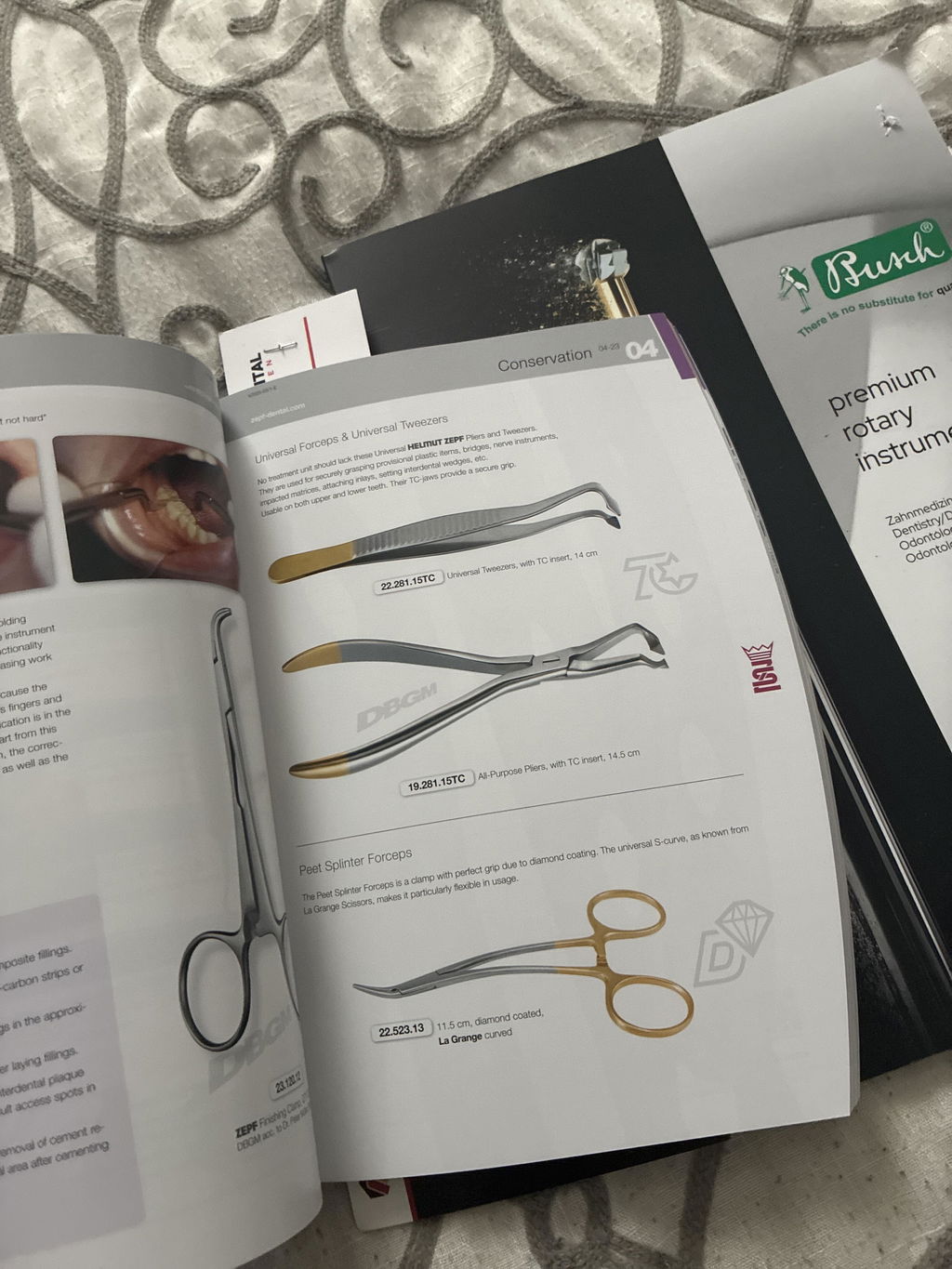
After the matrix comes off, excess at the proximal line angles is removed and the surface polished with abrasive finishing strips. Zepf’s StripGrip tweezers (22.998.14) lock the strip under tension in diamond-coated jaws, so it can be drawn through the embrasure with control instead of flexing loose in the fingers — protecting the freshly formed contact from being flattened.

FAQ
Why is my Class II contact open after the matrix is removed?
Usually the band was never in contact with the adjacent tooth while the composite cured — band gauge too thick, insufficient wedge separation, or no lateral loading. A contact-forming instrument held against the band during the cure of the proximal increment solves it directly.
Tofflemire or sectional — which should a practice standardize on?
Most practices need both: sectional for routine single-box Class II composites, Tofflemire for MODs, cusp replacement, amalgam, and any situation where the ring will not seat stably. Deutsche Dental Technologien currently stocks the Tofflemire side of that pairing, plus the EASY CONTACT POINT instruments that help a Tofflemire band form a tighter single-box contact.
Which Zepf instruments does this guide correspond to?
Tofflemire retainers in our Tofflemire collection, contact formers in the EASY CONTACT POINT collection, and strip tweezers via StripGrip. All are German-made by Helmut Zepf; call (917) 480-2682 ext 101 for pattern advice.
See also our Restorative Instrument Library, the Composite Instrument Shapes Guide, and our 2026 Guide to Dental Composite Instruments.
Part of our Restorative, Prosthetic & Diagnostic Instruments hub.