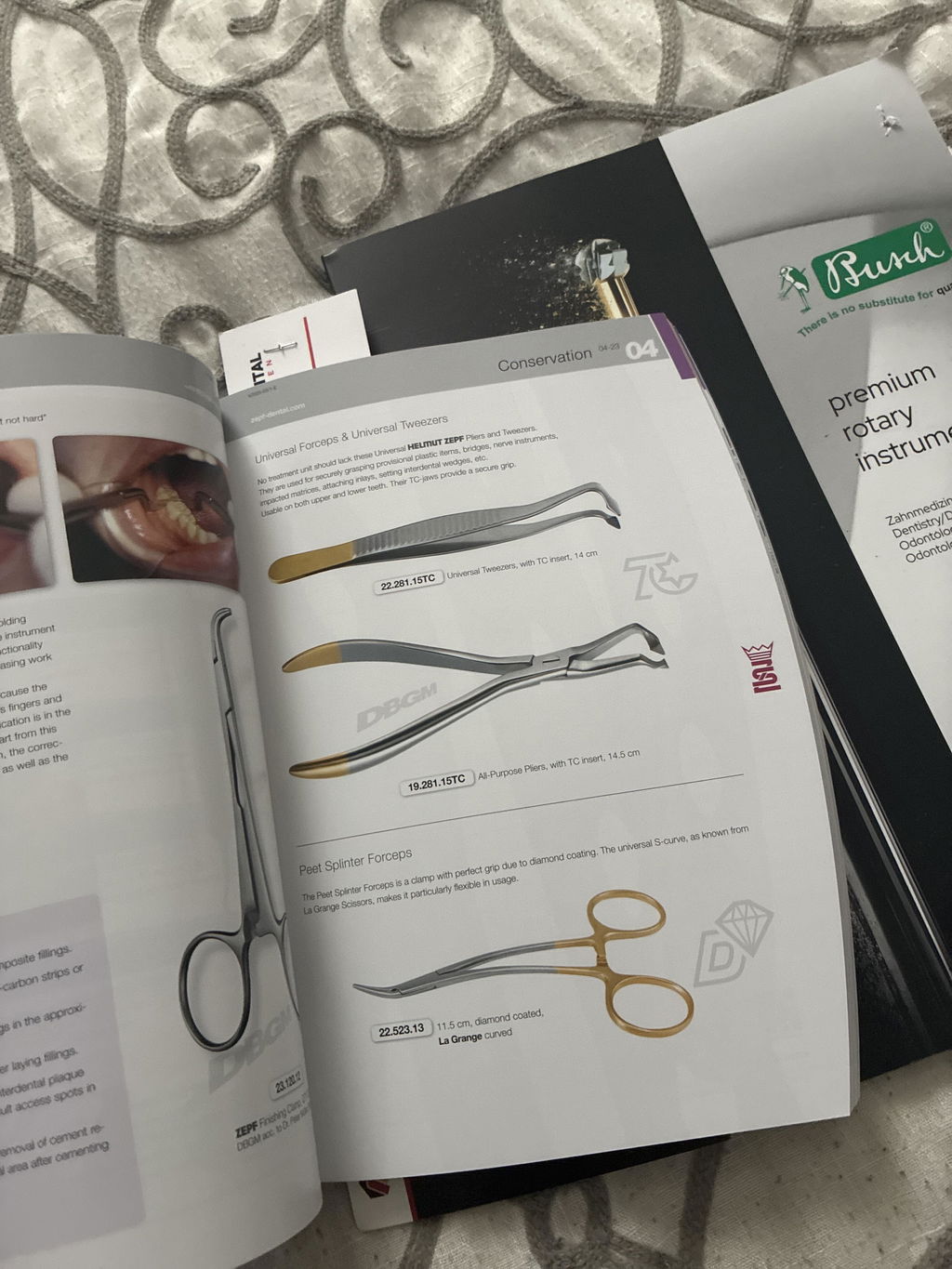
A well-organized dental hygienist tools setup separates efficient prophylaxis appointments from ones that run long and strain the wrist. This guide covers the core instruments hygienists reach for during scaling and root planing: sickle scalers, curettes, probes, and mirrors.
Instrument selection affects both outcomes and hand fatigue over a full patient day. The right pattern removes supragingival and subgingival calculus efficiently while limiting unnecessary tissue trauma, and a lightweight, well-balanced handle reduces cumulative strain across back-to-back hygiene visits.
Below is a practical set-up guide built around real dental hygiene instruments, organized by clinical step from initial assessment through subgingival instrumentation. For the full range of options, browse the Scaling & Root Planing Instruments collection.
Shop Scaling & Root Planing Instruments
View all-

Helmut Zepf GmbH
Regular price $47.99Unit price -
Helmut Zepf GmbH
Regular price $47.99Unit price -
Helmut Zepf GmbH
Regular price $47.99Unit price


Sickle Scalers for Supragingival Calculus Removal
Sickle scalers handle the first stage of most prophylaxis visits: breaking up supragingival calculus and coarse deposits just below the gingival margin before finer curette work begins. Their pointed tip and triangular cross-section deliver strong lateral pressure against tenacious deposits, which is why they are reserved for supragingival and just-subgingival calculus rather than deep pocket instrumentation.
Best for: Narrow interdental spaces in the premolar and frontal region call for a fine, controlled tip — the Sickle Scaler #204 SD is built specifically for that access.
Gracey and Universal Curettes for Subgingival Debridement
Once supragingival deposits are cleared, curettes take over for subgingival scaling and root planing. Gracey curettes are area-specific — each pattern is ground to reach one tooth surface at the correct angle — while universal curettes use a single blade geometry across multiple surfaces, trading some site-specific efficiency for fewer instruments on the tray.
Best for: Anterior teeth requiring a slightly angled, site-specific approach are well served by the Gracey Curette M5 Deep Scaling (GRA 1/2), whose M5 steel holds an edge through repeated sharpening.
Best for: A general-purpose anterior instrument that works both upper and lower arches is the Langer Universal Curette 5/6, a practical choice when tray space or sterilization turnaround is limited.
Periodontal Probes for Pocket Depth Assessment
Accurate probing depths drive every scaling and root planing decision, from which sites need subgingival instrumentation to whether a patient needs a periodontal referral. A probe with clearly marked, easy-to-read millimeter increments and a thin, rounded tip lets hygienists walk the sulcus without unnecessary tissue trauma.
The 14.5 cm Probe with a 1.0 mm tip is sized for routine six-point charting and fits comfortably alongside scalers and curettes in a standard hygiene set-up.
Mirrors and Ancillary Instruments
A quality mouth mirror is easy to overlook next to scalers and curettes, but indirect vision and retraction are what make posterior and lingual instrumentation possible without constantly repositioning the patient. Look for a mirror head that resists fogging and holds a sharp, undistorted reflection through repeated sterilization cycles.
The Dental Mirror Head (Size 4) threads onto a standard handle and gives the visibility needed to guide scaler and curette placement on posterior surfaces.
For a complete brand overview across categories, see the Helmut Zepf Dental Instrument Collection.
Choosing the Right Pattern
The table below summarizes how each instrument type fits into a scaling and root planing workflow, from initial calculus removal to final subgingival smoothing.
| Instrument | Key Trait | Best For |
|---|---|---|
| Sickle Scaler #204 SD | Fine, pointed tip | Narrow interdental spaces, supragingival calculus |
| Gracey Curette M5 (GRA 1/2) | Area-specific blade angle | Front teeth, precise subgingival root planing |
| Langer Universal Curette 5/6 | Single universal blade | General anterior debridement, streamlined tray set-up |
| Probe (1.0 mm tip) | Thin, marked tip | Six-point pocket depth charting |
FAQs
What tools do dental hygienists use for a routine scaling appointment?
A typical set-up includes a mouth mirror, periodontal probe, explorer, one or more sickle scalers for supragingival calculus, and Gracey or universal curettes for subgingival root planing.
What is the difference between a sickle scaler and a curette?
A sickle scaler has a pointed tip and triangular cross-section suited to supragingival and just-subgingival calculus, while a curette has a rounded toe and semicircular cross-section designed for subgingival root planing without traumatizing soft tissue.
Why choose an area-specific Gracey curette over a universal curette?
Gracey curettes are ground to a specific angle for one tooth surface, giving more precise adaptation in that area, while universal curettes use one blade geometry across multiple surfaces, reducing the number of instruments needed on the tray.
How often should hygiene instruments be sharpened?
Sharpen at the first sign of a dull edge, typically after every few patients for instruments used on tenacious calculus, since a dull blade increases the number of strokes needed and raises hand strain.
What probe increment is standard for periodontal charting?
Millimeter markings are standard for six-point pocket depth charting; probes with bold, easy-to-read increments reduce charting errors during a full hygiene schedule.
Do mirror head coatings matter for hygiene work?
Yes — a mirror surface that resists fogging and holds a clear, undistorted image through repeated autoclave cycles is important for reliable indirect vision on posterior and lingual surfaces.
Shop the full Scaling & Root Planing Instruments.