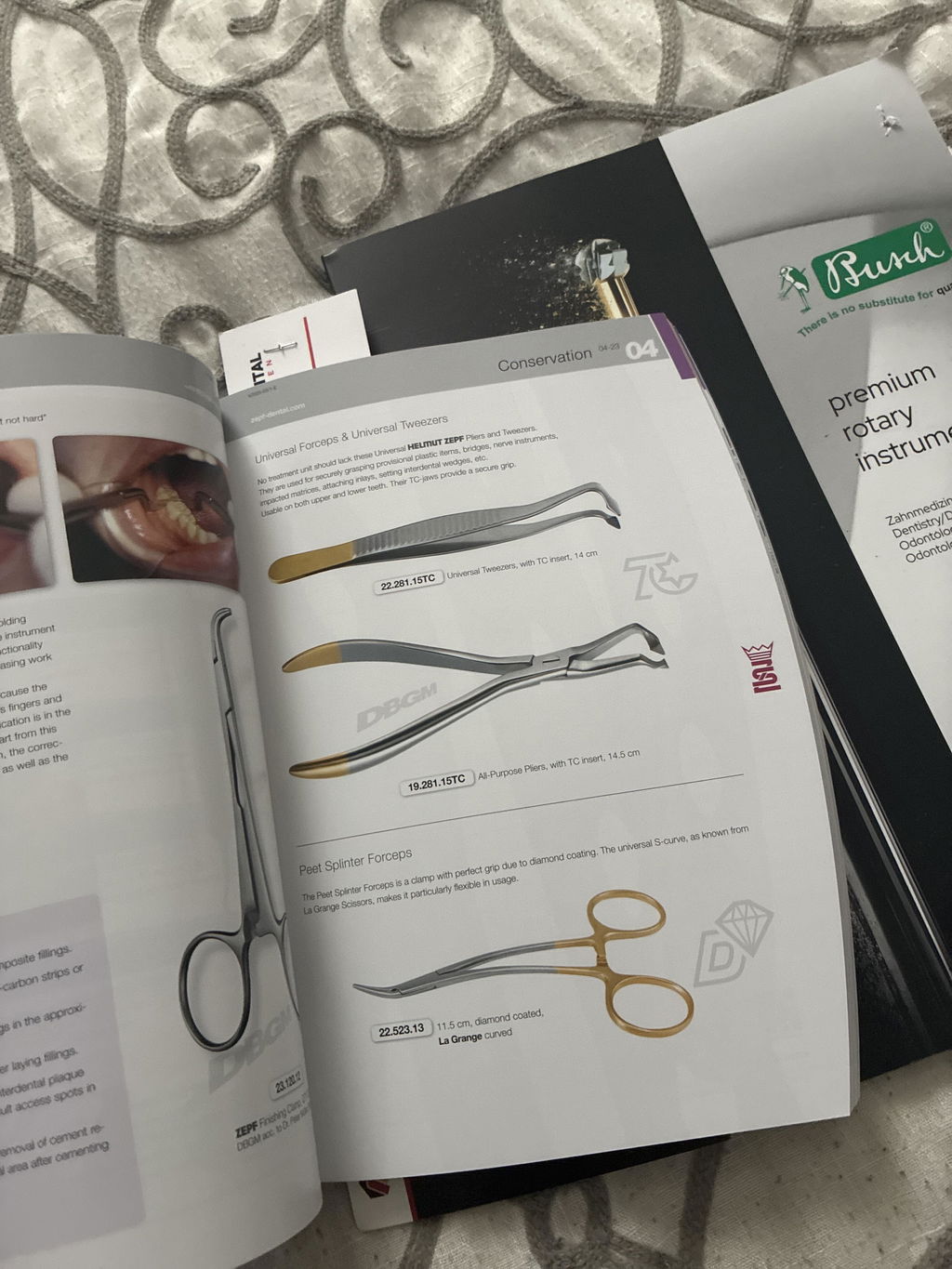
Every dental team relies on a shared vocabulary of instrument names to work efficiently at chairside. This illustrated reference breaks down dental instruments names and uses by category, so dentists, hygienists, and dental assistants can identify each pattern by sight and know exactly when to reach for it.
Revised on October 1, 2026
From diagnostic mirrors and explorers to oral surgery elevators and microsurgical needle holders, we cover the instruments most clinicians handle daily, explaining the design cues — tip shape, working end, handle style — that distinguish one pattern from another.
Shop Helmut Zepf Dental Instrument Collection
View all-

-
Helmut Zepf GmbH
Helmut Zepf Catalog - Hygiene / Prophylaxis Instruments
Regular price $0.00Unit price -


Every instrument pictured here is drawn from the Helmut Zepf Dental Instrument Collection, precision-forged in Germany and trusted across general, surgical, and specialty practices for consistent quality.
Diagnostic Instruments: Mirrors, Explorers, and Probes
Diagnostic instruments are the first tools into the mouth at every appointment, so their names are usually the first ones new clinical staff learn. The mouth mirror retracts soft tissue, reflects light onto surfaces the eye can't see directly, and protects the cheek and tongue during instrumentation. The explorer (sometimes called a probe) uses a fine, angled tip to detect carious lesions, defective margins, and calculus by tactile feel rather than sight alone.
Best for: routine exams, intraoral photography setups, and soft-tissue retraction during restorative work is the Dental Mirror with Retractor (Size 1), which pairs a Ø24 mm mirror head with a sterilizable bIONIK color-coded handle for fast tray identification.
Best for: tactile detection of caries, calculus, and margin discrepancies is the Single-Ended Dental Explorer #8, finished with an octagonal stainless steel handle for a secure, non-rolling grip.
Periodontal Instruments: Scalers and Curettes
Periodontal instruments remove deposits from the tooth surface and subgingival sulcus without traumatizing soft tissue. Sickle scalers feature a pointed tip and triangular cross-section built for supragingival calculus removal, while curettes use a rounded toe for safer subgingival access. Pattern names like Taylor, Kaplan, and Columbia refer to the original clinicians who designed the blade geometry, and hygienists typically standardize on two or three patterns to cover most quadrants.
Best for: supra- and subgingival calculus removal on posterior facial surfaces is the Taylor Sickle Scaler #T 2-3, built on a color-coded bIONIK handle to speed instrument selection mid-procedure.
Oral Surgery Instruments: Elevators and Raspatories
Once a flap needs to be raised or a root needs to be luxated, the instrument vocabulary shifts to elevators and raspatories. A periosteal elevator separates the periosteum from bone to reflect a mucoperiosteal flap cleanly, while a straight or curved root elevator applies wedging or wheel-and-axle force to loosen a tooth before extraction. Molt-pattern elevators, named for their double-ended design, remain a surgical-tray standard because one instrument covers both flap reflection and fine debridement.
Best for: initiating mucoperiosteal flap reflection before extractions or implant placement is the Molt Periosteal Elevator #1, sized at 7.5 mm / 4 mm for controlled, precise tissue separation.
Suturing Instruments: Needle Holders
Closing a surgical or periodontal site requires a needle holder matched to the suture size and access. Standard needle holders suit routine flap closures, while Castroviejo-pattern needle holders use a spring-loaded, spinlock mechanism and tungsten carbide jaw inserts for fine microsurgical suturing under magnification, where a conventional ratcheted handle would be too bulky.
Best for: microsurgical suturing of periodontal and implant sites under loupes or a microscope is the Castroviejo Needle Holder, Straight (18 cm), with tungsten carbide jaws for superior needle grip and control.
| Instrument | Common Pattern Names | Primary Use |
|---|---|---|
| Mouth Mirror | Front-surface, plane, retractor mirror | Visualization, retraction, indirect vision |
| Explorer | Shepherd's Hook, #23, #17 | Tactile detection of caries, margins, calculus |
| Sickle Scaler | Taylor, Kaplan, Columbia | Supragingival calculus removal |
| Periosteal Elevator | Molt, Woodson, Freer | Flap reflection, periosteum separation |
| Needle Holder | Castroviejo, Mathieu, Crile-Wood | Suture placement and knot tying |
Quick Self-Check: Name the Instrument
Use this to test yourself or to train new assistants. Read each clue, name the instrument, then open the answer.
- A fine, angled tip you use to feel for caries, calculus and defective margins.
Answer
Explorer, such as the #23 Shepherd's Hook. - A pointed tip with a triangular cross-section, built for supragingival calculus.
Answer
Sickle scaler, such as the Taylor T 2-3. - A rounded toe and back that let you work subgingivally on the root surface without cutting soft tissue.
Answer
Curette, such as a Gracey. - Graduated millimeter markings that measure pocket depth.
Answer
Periodontal probe. - Separates the periosteum from bone so a full-thickness flap can be reflected.
Answer
Periosteal elevator, such as the Molt #1. - A beveled blade pushed or pulled across bone to recontour it in osseous surgery.
Answer
Periodontal chisel. See the periodontal chisels guide. - Pointed beaks that seat into the bifurcation of a lower molar and turn grip into lift.
Answer
#23 cowhorn extraction forceps. See the extraction forceps numbers guide. - A spring handle, spinlock and tungsten carbide jaws for suturing under magnification.
Answer
Castroviejo needle holder. See the Castroviejo guide.
FAQs
What are dental instruments called by name?
Most dental tools names combine a function word with a pattern name — for example, "Molt periosteal elevator" or "Castroviejo needle holder." The pattern name usually credits the clinician who originated that specific tip or handle design.
What are the basic dental instruments every dentist uses?
Nearly every basic dental instruments kit includes a mouth mirror, an explorer, cotton pliers, and a periodontal probe for exams, plus scalers and curettes for hygiene visits and elevators, forceps, and needle holders for surgical procedures.
Is there a reference showing dental instruments names and pictures together?
Yes — this guide pairs each instrument category with a real product photo and its clinical use, and the full catalog linked below shows dental instruments names and pictures for every pattern Helmut Zepf manufactures. For a one-page summary of dental tools names, patterns and uses, download the printable Dental Instruments: Names and Uses chart (PDF).
What are the names of dental tools used specifically in oral surgery?
Oral surgery trays typically include periosteal elevators, root elevators, rongeurs, bone curettes, raspatories, and needle holders, in addition to the diagnostic mirrors and explorers used during the initial exam.
How can I tell two similar-looking instrument patterns apart?
Look at the tip geometry, the angle of the working end relative to the handle, and any manufacturer number stamped on the instrument — small differences in curvature or cross-section define distinct patterns even when the overall silhouette looks similar.
Are Helmut Zepf instruments different from generic dental tools?
Helmut Zepf instruments are precision-forged in Germany to tight tolerances, with tip geometry and balance calibrated to each named pattern, so the instrument performs consistently the way its pattern name implies.
Shop the full Helmut Zepf Dental Instrument Collection.