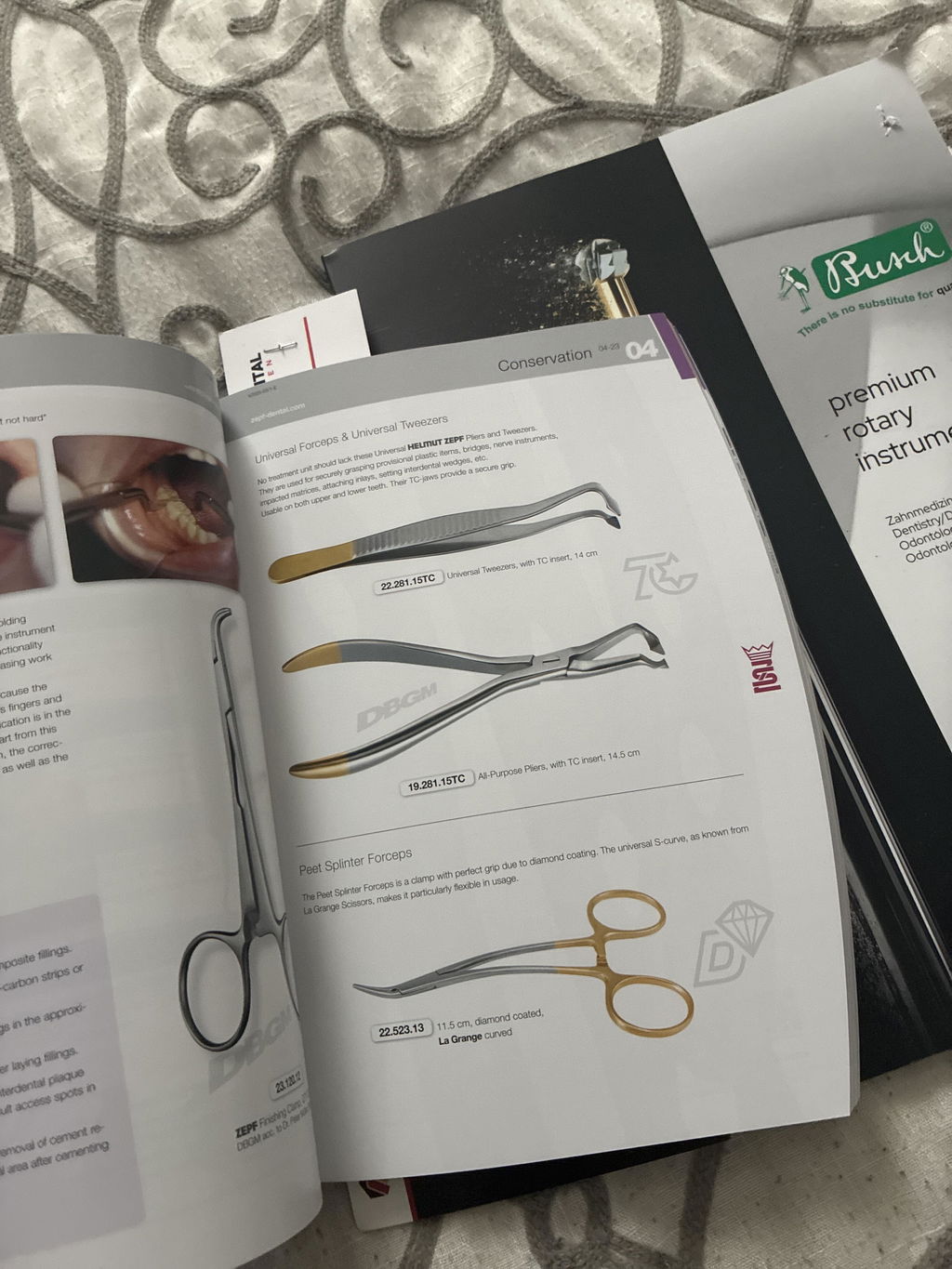
Few instruments in restorative dentistry have earned the staying power of the dental Tofflemire matrix system. Introduced by Dr. Benjamin F. Tofflemire in the 1940s, the retainer-and-band design remains a daily workhorse in operatories worldwide for Class II amalgam and composite restorations. This guide covers how the system works, which retainer and band configurations to choose, a step-by-step placement protocol, and how the Tofflemire compares to sectional matrix systems — with links to the German-made Helmut Zepf components we stock in our US warehouse.
Revised on October 1, 2026
What Is a Tofflemire Matrix System?
A Tofflemire system has two components: a reusable matrix retainer and a single-use matrix band. The retainer holds a thin stainless steel band in a loop around the prepared tooth, temporarily replacing the missing proximal wall so restorative material can be condensed against a defined contour. Once the material is placed, the band is released and removed, leaving a properly shaped proximal surface.
Shop Tofflemire Collection
View all-

Helmut Zepf GmbH
Universal Matrix Retainer, Tofflemire | Helmut Zepf No. 19.060.00
Regular price $89.99Unit price -
Helmut Zepf GmbH
Junior 1, Straight Matrix Retainer, Tofflemire | Helmut Zepf No. 19.063.01
Regular price $89.99Unit price -
Helmut Zepf GmbH
Senior Matrix Retainer, Tofflemire | Helmut Zepf No. 19.062.00
Regular price $89.99Unit price


The retainer itself consists of a head with a diagonal slot, a spindle that clamps the band, an inner (rotating) knob that tightens the spindle, and an outer (adjusting) knob that opens or closes the band loop. Because the head slot faces gingivally when placed, the same retainer can be positioned from the buccal aspect in either arch.
Tofflemire Retainer Types
Our Tofflemire Collection includes three Helmut Zepf retainer configurations, each machined in Germany from surgical stainless steel and designed for repeated sterilization cycles:
- Universal Matrix Retainer, Tofflemire | Helmut Zepf No. 19.060.00 — the standard straight-head retainer for everyday posterior restorations in both arches. If you stock one retainer, this is it.
- Senior Matrix Retainer, Tofflemire | Helmut Zepf No. 19.062.00 — a full-size retainer suited to adult dentition and deeper preparations.
- Junior 1, Straight Matrix Retainer, Tofflemire | Helmut Zepf No. 19.063.01 — a compact straight retainer for smaller mouths, pediatric patients, and limited-access situations.
Tofflemire Matrix Bands: Sizes and Selection
Matrix bands are single-use items for infection control compliance, supplied in packs of 12 and available in multiple sizes to match tooth morphology and preparation depth. All four Helmut Zepf band sizes below fit the 19.060.00 universal retainer:
- Matrix Bands for Tofflemire, #1 (Pack of 12) | No. 19.061.01
- Matrix Bands for Tofflemire, #2 (Pack of 12) | No. 19.061.02
- Matrix Bands for Tofflemire, #3 (Pack of 12) | No. 19.061.03
- Matrix Bands for Tofflemire, #13 (Pack of 12) | No. 19.061.13
As a general rule, select the narrowest band that fully covers the gingival margin of the preparation. A band that extends too far occlusally is harder to burnish and can interfere with contact formation; one that is too narrow risks a gingival overhang.
How to Place a Tofflemire Matrix Band: Step by Step
- Fold and load the band. Bring the band ends together to form a loop. The gingival edge (smaller circumference) faces the knobs; the occlusal edge (larger circumference) faces away.
- Seat the band in the retainer. Slide both band ends into the diagonal slot of the head and into the spindle channel, then tighten the inner knob to lock the band.
- Orient the retainer. Position the head slot facing gingivally so the retainer can be removed occlusally after placement. Place from the buccal aspect.
- Seat and tighten. Slip the loop over the tooth, seat the gingival edge about 1 mm apical to the gingival margin of the preparation, and rotate the outer knob to close the band snugly.
- Wedge. Insert a wooden or plastic wedge interproximally from the wider embrasure to seal the gingival margin and create slight separation to compensate for band thickness.
- Burnish. Burnish the band against the adjacent tooth at the contact area before placing restorative material — this is the single most important step for achieving a tight proximal contact with a Tofflemire.
- Condense and contour. Place and condense your restorative material against the band. For amalgam and bulk-fill composite, our condensers and pear-shaped pluggers are designed for exactly this task.
- Remove. Loosen the inner knob, lift the retainer free, then gently tease the band out occlusally with a rocking motion — after initial set for amalgam, or after light-curing the proximal increment for composite.
Tofflemire vs. Sectional Matrix Systems
Sectional matrices with separation rings generally produce tighter, more anatomically contoured contacts for two-surface Class II composites, and many clinicians default to them for routine MO/DO cases. The Tofflemire, however, keeps clear advantages in several situations:
- MOD and multi-surface preparations, where a circumferential band stabilizes both proximal walls at once.
- Amalgam restorations, where condensation pressure demands the rigidity of a clamped circumferential band.
- Cusp-replacement and deep subgingival cases, where sectional ring placement is unstable.
- Cost and simplicity — one retainer, a box of bands, and wedges cover the entire posterior dentition.
Most well-equipped operatories keep both. If contact tightness with a Tofflemire is a recurring frustration, pre-contouring and firm burnishing solve most cases; Helmut Zepf's EASY CONTACT POINT instruments were developed specifically to press the matrix against the adjacent tooth while curing. For a situation-by-situation comparison of both systems — band gauges, wedging, and contact-formation technique — see our Dental Matrix Systems & Contact Point Guide.
Building Out the Restorative Setup
The Tofflemire is one link in the Class II chain. The supporting instruments we recommend pairing with this collection:
- Rubber Dam Forceps — isolation before matrix placement.
- Cavity Preparation Burs and the Busch 1SX Excavating Bur — preparation and caries excavation.
- Filling Removal Burs — replacing failed restorations before matrix work begins.
- Spoon Excavators — final caries removal at the gingival floor.
- Composite Instruments, including ball-shaped pluggers and the CompoSMOOTH line — placement and contouring. Not sure which shape does what? Our Composite Instrument Shapes Guide maps every working end to its step.
- Articulating Paper Forceps — occlusal verification after band removal.
Care and Sterilization
Tofflemire retainers are reusable and built for autoclave cycles; matrix bands are disposed of after a single use. Disassemble the retainer fully (band removed, spindle backed off) before cleaning so the spindle channel and head slot are accessible. Full reprocessing parameters for Helmut Zepf hand instruments are in our Instrument Reprocessing & Sterilization Guide.
Frequently Asked Questions
What is a Tofflemire used for?
A Tofflemire retainer and matrix band temporarily replace the missing proximal wall of a Class II preparation, allowing amalgam or composite to be condensed against a defined contour and restoring the interproximal contact.
Which way does the Tofflemire band go in?
The smaller (gingival) circumference of the folded band faces the retainer knobs, and the head slot faces gingivally, so the retainer can be lifted off occlusally after the restoration is placed.
Are Tofflemire retainers autoclavable?
Yes. Helmut Zepf retainers are German surgical stainless steel and designed for repeated steam sterilization. Bands are single-use.
Can I use a Tofflemire with composite?
Yes. Burnish the band firmly at the contact area, wedge well, and consider a contact-forming instrument. For routine two-surface composites, many clinicians alternate between Tofflemire and sectional systems depending on the case.
Browse the complete Tofflemire Collection — retainers and bands by Helmut Zepf, made in Germany, shipped fast from our US warehouse. Manufacturer flyers and the full factory catalog live in our Restorative Instrument Library. Questions on configuration or band selection? Call our experts at (917) 480-2682 ext 101 or explore the full Helmut Zepf Instrument Collection.