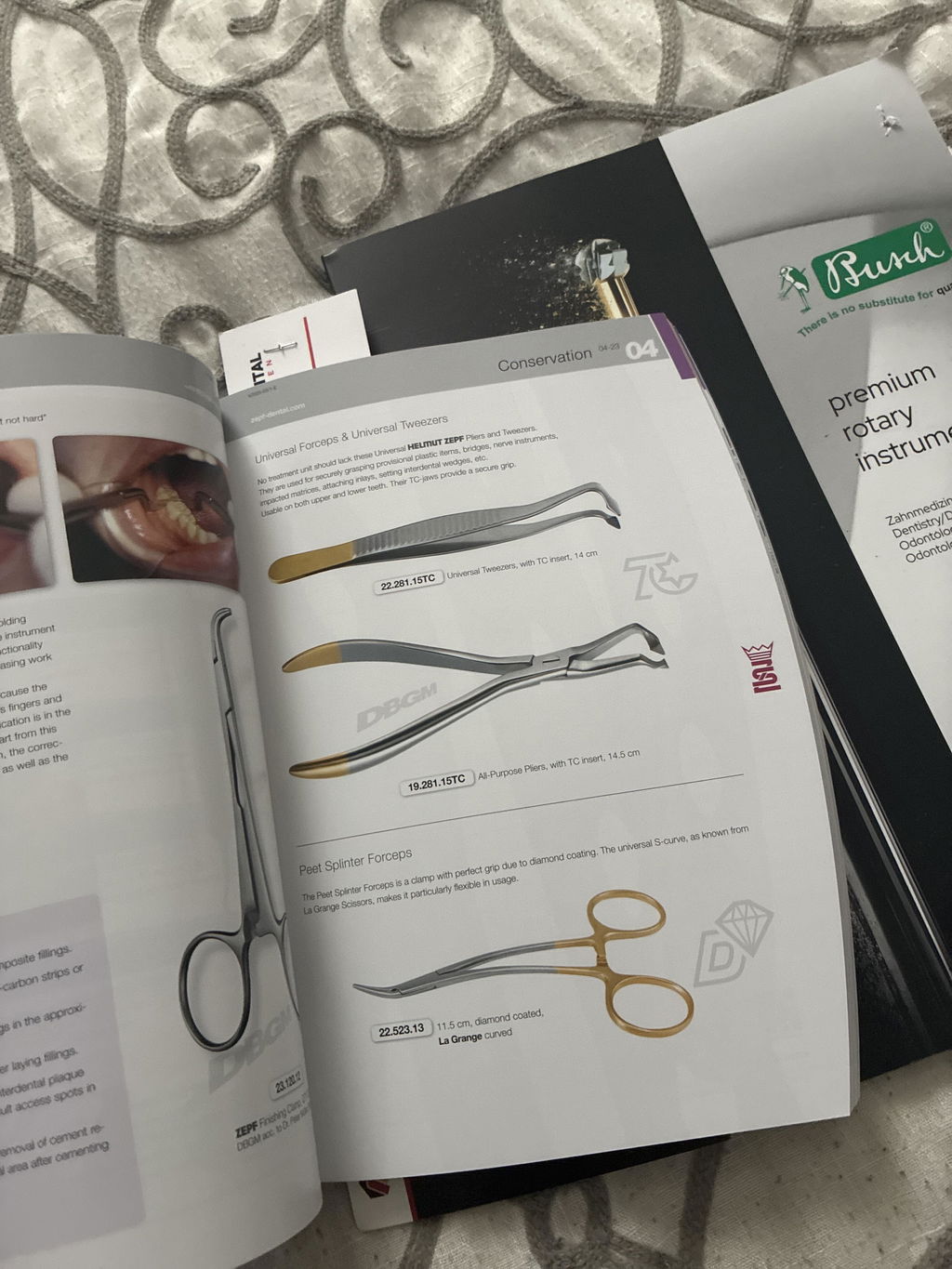
Choosing the correct type of scaler for a given surface is one of the fastest ways to speed up debridement and reduce tissue trauma during periodontal therapy. Sickle scalers, universal curettes, and area-specific Gracey curettes each have a distinct blade geometry built for a specific job, and mixing them up costs chair time.
Revised on October 1, 2026
This guide breaks down how each hand scaler category is designed, when to reach for it, and how area-specific patterns differ from universal curettes for subgingival root planing. You'll also see where each pattern fits within a full Scaling & Root Planing setup.
Shop Scaling & Root Planing Instruments
View all-

Helmut Zepf GmbH
Regular price $47.99Unit price -
Helmut Zepf GmbH
Regular price $47.99Unit price -
Helmut Zepf GmbH
Regular price $47.99Unit price


Whether you're building a new hygiene kit or replacing a worn pattern, matching blade to surface starts here.
Sickle Scalers: Built for Supragingival Deposits
A sickle scaler is the workhorse for supragingival calculus and heavy interproximal deposits above the gumline. The blade has two straight cutting edges that meet at a pointed tip in cross-section, forming a triangular shape that concentrates force for fracturing bonded calculus efficiently. Because the tip is pointed and the back is thick, sickle scalers are not meant to go subgingivally — the sharp point can gouge soft tissue.
Best for: Removing supragingival ledges and interproximal deposits before root planing begins. The Sickle Scaler #204 S is shaped specifically for interdental spaces in the molar region, giving reliable access to line angles that a straight-shanked scaler can't reach.
Universal Curettes: One Blade Geometry, Every Surface
Universal curettes carry a rounded back and toe with a blade set at 90 degrees to the lower shank, and both cutting edges are usable. That symmetry is what makes them "universal" — the same instrument adapts to mesial, distal, facial, and lingual surfaces around the mouth with a change in wrist angulation rather than a change in instrument. They work supra- and subgingivally, making them a practical single-instrument option for general scaling.
Best for: Full-mouth maintenance visits where switching between six or eight area-specific curettes isn't practical. The Columbia 4R/4L Universal Curette is sized for posterior teeth and holds an edge well across repeated subgingival passes.
The main universal patterns are the Columbia, Langer, and McCall curettes. Because both edges work, a single double-ended universal adapts to mesial and distal, buccal and lingual, anterior and posterior surfaces, which means fewer instrument changes and fewer instruments to sterilize.
Columbia vs. Langer: Two Universal Patterns
The Columbia curette has a moderately curved blade with a rounded back, giving broad access for general supragingival and shallow subgingival scaling across the full mouth. It is often the first universal added to a starter set. Best for: full-arch general maintenance — the Columbia #2R/2L Universal Curette.
The Langer curette borrows the shank angulation of a Gracey but keeps two cutting edges, so you get Gracey-style subgingival access without switching instruments for the opposite surface. It is a practical middle ground between universal and area-specific instrumentation, though it does not fully replace a Gracey set for deep, area-specific work. Best for: subgingival scaling with universal flexibility on anterior teeth — the Langer #5/6 Universal Curette.
Gracey and Other Area-Specific Curettes: Matching Blade to Tooth Surface
Area-specific curettes solve the tradeoff universal curettes can't: only one of the two cutting edges is functional, and the blade is offset roughly 60-70 degrees from the lower shank. That offset lets the working edge stay properly angulated against the root surface without over-rotating the handle, which means less tissue distention and a cleaner root surface at the end of the stroke. The Gracey series is numbered by tooth region — 1/2 and 3/4 for anteriors, 7/8 for facial and lingual surfaces of posteriors, 11/12 for mesial surfaces, and 13/14 for distal surfaces.
Best for: Deep pockets and root debridement where precise adaptation matters more than speed. The Gracey Curette GRA 5/6 is designed for anterior and premolar teeth and has a longer terminal shank than the 1/2 and 3/4 anterior patterns, making it a common choice for anterior and premolar line angles once initial debridement is complete. The 7/8 and higher patterns are more sharply angled for posterior teeth.
For a number-by-number breakdown of every Gracey pattern, see our Gracey Curette Numbers & Types Guide.
Building a Scaling Sequence: From Calculus Removal to Root Planing
Most periodontal instrumentation follows a sequence rather than a single instrument choice. Gross supragingival deposits come off first with a sickle scaler, coarse subgingival calculus is broken up with a universal curette, and final root planing on periodontally involved surfaces is finished with the appropriate area-specific Gracey pattern. Skipping straight to a fine curette on heavy calculus wastes strokes and dulls the edge faster than necessary.
The table below summarizes how the three scaler types compare on blade design and where each fits in that sequence.
| Type of Scaler | Blade Design | Primary Use |
|---|---|---|
| Sickle Scaler | Pointed tip, triangular cross-section | Supragingival calculus |
| Universal Curette | Rounded toe, 90° blade, two cutting edges | Supra- and subgingival, general scaling |
| Gracey (Area-Specific) Curette | Rounded toe, offset blade, one cutting edge | Subgingival root planing by tooth surface |
Deep Pockets and Implants: M5 and Titanium Curettes
Two situations call for something beyond the standard set. In narrow, deep pockets where a standard blade will not seat, add blades from the M5 Deep Scaling Instruments range. For implant maintenance, switch to titanium curettes, because steel blades scratch titanium abutments and implant collars.
Keeping the Edge: Sharpening and Insert Handles
A dull curette burnishes calculus smooth instead of removing it, and the burnished deposit is harder to detect afterward. Zepf's interchangeable-insert handles (bIONIK and Z-SHAPE Relax) let you replace a worn blade without discarding the whole instrument. Between replacements, maintain blade geometry with sharpening accessories or our factory-certified sharpening and reconditioning service.
FAQs
What is the main difference between a scaler and a curette?
A dental scaler is designed for supragingival calculus: a sickle scaler has a pointed tip, while a hoe scaler has a single straight cutting edge set at about 100° to the shank and is used with a pull stroke. A curette has a rounded toe and can safely be worked subgingivally without traumatizing the sulcus.
What type of scaler should a new hygienist start with?
Most programs start with a universal curette and a sickle scaler, since together they cover supragingival deposits and general subgingival scaling before area-specific patterns are introduced.
Are Gracey curettes considered hand scalers?
Yes. Gracey curettes fall under the broader hand scaler category along with sickles and universal curettes — the term simply refers to any non-powered, hand-activated scaling instrument.
How many Gracey curettes make up a full set?
A traditional set has seven to eight patterns (1/2, 3/4, 5/6, 7/8, 11/12, 13/14, plus 15/16 and 17/18 for some manufacturers), though many clinicians pare this down to a working set of four or five for routine periodontal maintenance.
Can universal curettes replace area-specific curettes entirely?
For routine maintenance, yes — many hygienists rely on universal curettes for most visits. For deep pockets, furcations, or heavy root irregularities, area-specific curettes still adapt more precisely and are worth keeping in the operatory.
Do dental curettes need to be sharpened differently than scalers?
The sharpening angle differs slightly because of blade geometry, but the principle is the same: maintain the original bevel angle and sharpen before the edge is visibly dull, not after.
What is a dental scaler?
A dental scaler is a hand instrument for removing calculus, plaque and stain from tooth surfaces above and at the gumline. The sickle scaler, with its pointed tip and triangular cross-section, is the most common type; because the tip is sharp, it stays supragingival. Browse the Sickle Scaler Collection for anterior and posterior patterns.
What is a dental curette?
A dental curette is a scaling instrument with a rounded toe and rounded back, which lets it work below the gumline without gouging the sulcus. Curettes are either universal (two cutting edges, blade at 90 degrees to the shank) or area-specific, like the Gracey series, with one cutting edge offset for a particular tooth surface. They do the subgingival scaling and root planing a sickle cannot.
What is a universal curette?
A universal curette has a blade set at 90 degrees to the lower shank with both cutting edges sharpened, so one double-ended instrument adapts to mesial, distal, facial and lingual surfaces around the whole mouth. Columbia, Langer and McCall are the main universal patterns. See the Universal Curette collection for every size and handle option.
What is a Columbia curette?
The Columbia curette is a universal curette with a moderately curved blade and a rounded back, used for general supragingival and shallow subgingival scaling across the full arch. Zepf makes it in the 2R/2L, 4R/4L and 13/14 patterns, the 4R/4L being the posterior size. Shop the Columbia Universal Curette collection; for the area-specific numbering system, see our Gracey Curette Numbers & Types Guide.
Shop the full Scaling & Root Planing Collection.