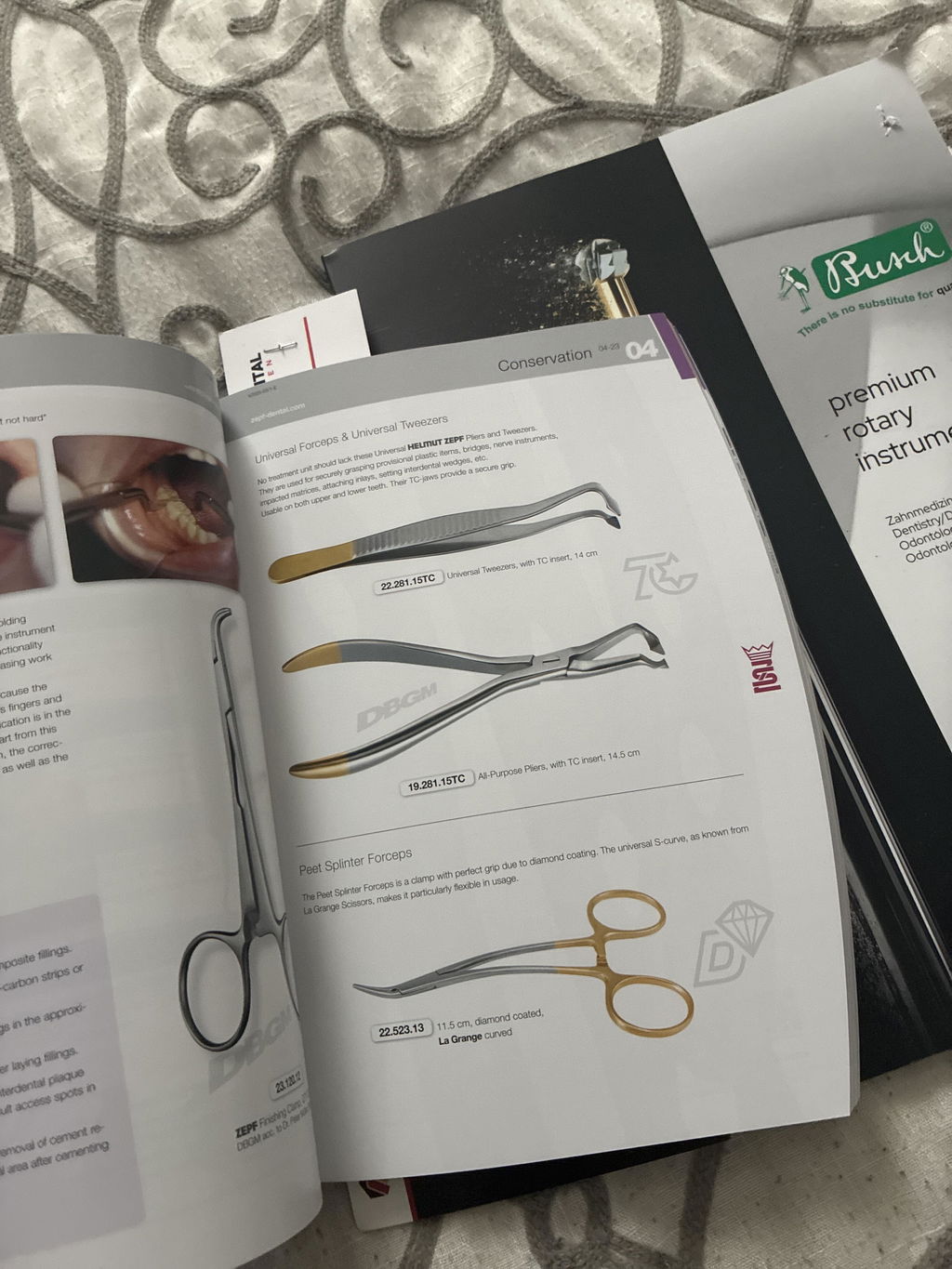
Ask five oral surgeons which periosteal elevator they reach for first and you'll likely hear three different names: Woodson, Molt, and Freer. Each pattern comes from a different clinical lineage, and a woodson elevator handles flap work differently than a Molt or Freer blade.
Helmut Zepf's German-manufactured periosteal elevators line doesn't carry a product labeled Woodson, but its Molt and Freer patterns cover the same clinical territory under precise catalog numbers.
This guide cross-references all three blade geometries — broad and pointed, fine and double-ended, flat and wide — against the exact Zepf reference numbers you'll actually order.
Shop Dental Periosteal Elevators by Helmut Zepf
View all-

Helmut Zepf GmbH
Regular price $109.99Unit price -
Helmut Zepf GmbH
Regular price $109.99Unit price -
Helmut Zepf GmbH
MOLT Periosteal Elevator - CM4/CM7, 3.6 / 7.0 mm Diameter | Helmut Zepf No. 41.862.20
Regular price $89.99Unit price


Why Pattern Names and Zepf Numbers Don't Always Line Up
Woodson, Molt, and Freer are surgeon or manufacturer names attached to blade shapes decades ago, long before any single company owned the terminology. Helmut Zepf, like most German manufacturers, catalogs instruments by reference number and tip geometry rather than by the historical eponym. That's efficient for inventory control, but it means a clinician trained on "a Woodson" or "a #9 Molt" has to translate before placing an order. The cross-reference below does that translation using the actual product listings in Zepf's periosteal elevator range, part of the broader Dental Elevators & Periosteals hub.
Molt Pattern — The Broad, Double-Ended Workhorse
The Molt pattern is built around a broad, slightly convex blade at one end and a narrower, more pointed tip at the other — one end for bulk periosteal reflection, the other for tight interproximal or interradicular access. It remains the default general-purpose choice among periosteal elevators on most oral surgery trays.
Best for: general full-thickness flap elevation — the Molt Periosteal Elevator #1 pairs a 7.5 mm and 4 mm double end for routine extractions and implant site access.
Best for: the classic molt 9 periosteal elevator profile — the Molt Periosteal Elevator #9 keeps the wider 7.0 mm / 4.6 mm double-ended blade most US-trained surgeons picture when they say "a #9 Molt."
Freer Pattern — Fine, Double-Ended Control
Where the Molt favors bulk, the Freer pattern trades blade width for finesse. Both working ends taper to a narrower, sharper profile, making it the instrument of choice when tissue needs careful, controlled separation rather than broad reflection — anterior aesthetic zone flaps, sinus lift access, and sites where over-instrumentation risks papilla or membrane damage.
Best for: aesthetic-zone and membrane-adjacent flap work — the Freer Elevator/Curette #1 combines a 4 mm elevator tip with an 8 mm curette end for controlled reflection and cleanup in one instrument.
Woodson Pattern — Flat-Bladed Geometry and Its Closest Zepf Cross-Reference
The Woodson pattern was originally developed as a double-ended packing and plastic instrument — a flat, spatula-like blade at one end and a small ball or cleoid at the other — and some clinicians press it into service as an improvised periosteal elevator because of its broad, flat working edge. Helmut Zepf doesn't manufacture an instrument marketed under the Woodson name, so there is no direct one-to-one SKU. The closest match in blade geometry and clinical function within the German catalog is a broad, flat-profile periosteal elevator rather than a narrow double-ended pattern.
Best for: clinicians substituting a Woodson-style flat blade for periosteal work — the Perforated Periosteal Elevator offers a comparably broad working edge purpose-built for flap elevation rather than restorative packing.
Quick Cross-Reference Table
| Pattern | Key Trait | Best For |
|---|---|---|
| Woodson | Flat, spatula-style blade; originally a packing/plastic instrument | Closest Zepf match: Perforated Periosteal Elevator |
| Molt | Broad convex blade + narrower pointed tip, double-ended | Molt Periosteal Elevator #1 / Molt Periosteal Elevator #9 |
| Freer | Fine, tapered double-ended blade | Freer Elevator/Curette #1 |
FAQs
Does Helmut Zepf make a Woodson periosteal elevator?
No. Zepf catalogs the Molt, Freer, and several house-designed periosteal patterns, but not an instrument labeled Woodson. The Perforated Periosteal Elevator is the closest match by blade geometry.
What's the difference between a Molt #1 and a Molt #9?
They differ in blade width and tip radius rather than the basic double-ended concept. The #1 (Zepf 41.862.11) pairs 7.5 mm/4 mm ends, while the #9 pattern (Zepf 41.862.13) uses a 7.0 mm/4.6 mm double end that closely matches the historical #9 Molt shape.
When should I choose a Freer over a Molt?
Choose Freer when the site calls for narrower, more delicate blade control — sinus membrane elevation, anterior aesthetic flaps, or areas close to a nerve or membrane where a wider Molt blade risks over-reflection.
Are these instruments autoclavable?
Yes. All instruments in Zepf's periosteal elevator range are manufactured from German surgical stainless steel and are fully autoclavable and corrosion-resistant.
Can one instrument replace both a Molt and a Freer on a tray?
Some double-ended combination periosteal elevators pair a broader tip with a finer one, but for procedures needing both broad reflection and delicate control, most surgeons still carry a dedicated pattern of each rather than compromising on one combination blade.
How do I know which Zepf reference number to order?
Match blade width and tip shape to the procedure first, then cross-reference against the specific SKU — numbers like 41.862.11, 41.862.13, and 41.864.01 map directly to the Molt #1, Molt #9, and Freer #1 patterns respectively.
Shop the full Dental Periosteal Elevators by Helmut Zepf.