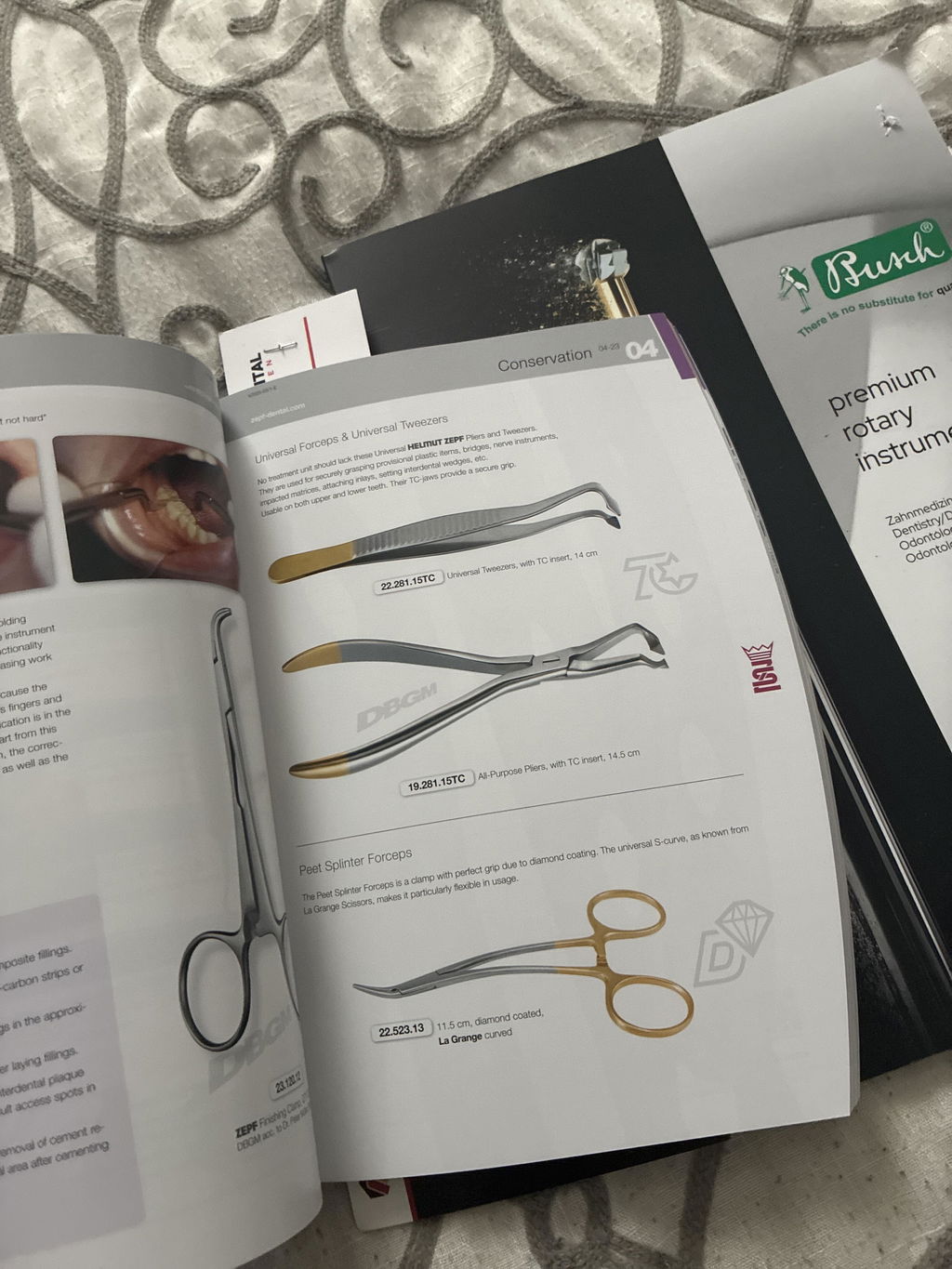
Universal Curette
The universal curette is an essential instrument in modern dental practice, designed to adapt to multiple tooth surfaces and sites throughout the mouth. Unlike area-specific instruments, the universal curette features a blade that can be adapted to virtually any tooth surface with proper technique, making it one of the most versatile tools available to dental professionals.
Key Features of the Universal Curette
- Dual cutting edges: Both lateral edges of the blade are sharp and usable, providing flexibility during scaling and root planing procedures.
- Rounded toe: Minimizes soft tissue trauma during subgingival instrumentation.
- 90-degree blade angle: The face of the blade meets the lower shank at approximately 90 degrees, enabling adaptation to multiple surfaces.
- Balanced design: Ergonomic handles reduce clinician fatigue during extended procedures.
Clinical Applications
The universal curette is widely used for supragingival and subgingival scaling, root planing, and the removal of calculus deposits from all surfaces of the dentition. Its adaptability means fewer instrument exchanges during a procedure, improving workflow efficiency for hygienists and periodontists alike.
When selecting a universal curette , practitioners typically consider shank length and flexibility, blade size, and handle diameter to match their individual technique preferences and the specific needs of each patient case.
Care and Maintenance
Proper sterilization and regular sharpening are critical to maintaining the performance of any universal curette . A sharp blade ensures effective calculus removal with minimal lateral pressure, reducing the risk of iatrogenic damage to root surfaces.
History: Who Invented the Universal Curette?
The universal curette's lineage traces to John Mankey Riggs (1811–1885), the Hartford dentist often called the father of American periodontics, who ground his own scaling instruments to treat what was then known as "Riggs' disease." One of his followers, W. J. Younger, developed a set of scaling instruments in the 1880s that stayed in wide use well into the twentieth century. Younger's student Robert Good later modified that design into what catalogs still sell as the Younger-Good curette — a double-edged, non-area-specific pattern that predates Dr. Clayton Gracey's area-specific curettes, developed with Hu-Friedy in the 1930s–40s, by half a century. Zepf's universal curettes descend directly from that adaptable, one-instrument-many-surfaces approach.

FAQ
What distinguishes a universal curette from a Gracey curette? A universal curette has two usable cutting edges and can be adapted to all tooth surfaces, while a Gracey curette is area-specific with one cutting edge offset at a 70-degree angle.
Can a universal curette be used subgingivally? Yes, the rounded back and toe design of the universal curette make it suitable for careful subgingival instrumentation.
Part of the Scaling & Root Planing Instruments hub. See also our Gracey Curette Numbers & Curette Types Guide for how universal patterns compare to area-specific designs.

Helmut Zepf GmbH
Regular price $47.99Unit price-
Helmut Zepf GmbH
Regular price $99.99Unit price -
Helmut Zepf GmbH
Regular price $47.99Unit price -
Helmut Zepf GmbH
Regular price $99.99Unit price -
Helmut Zepf GmbH
Regular price $99.99Unit price -
Helmut Zepf GmbH
Regular price $89.99Unit price -
Helmut Zepf GmbH
Regular price $49.99Unit price -
Helmut Zepf GmbH
Regular price $89.99Unit price -
Helmut Zepf GmbH
Regular price $89.99Unit price -
Helmut Zepf GmbH
Regular price $47.99Unit price -
Helmut Zepf GmbH
Regular price $49.99Unit price -
Helmut Zepf GmbH
Regular price $239.99Unit price -
Helmut Zepf GmbH
Regular price $49.99Unit price -
Helmut Zepf GmbH
Regular price $47.99Unit price -
Helmut Zepf GmbH
Regular price $49.99Unit price -
Helmut Zepf GmbH
Regular price $89.99Unit price