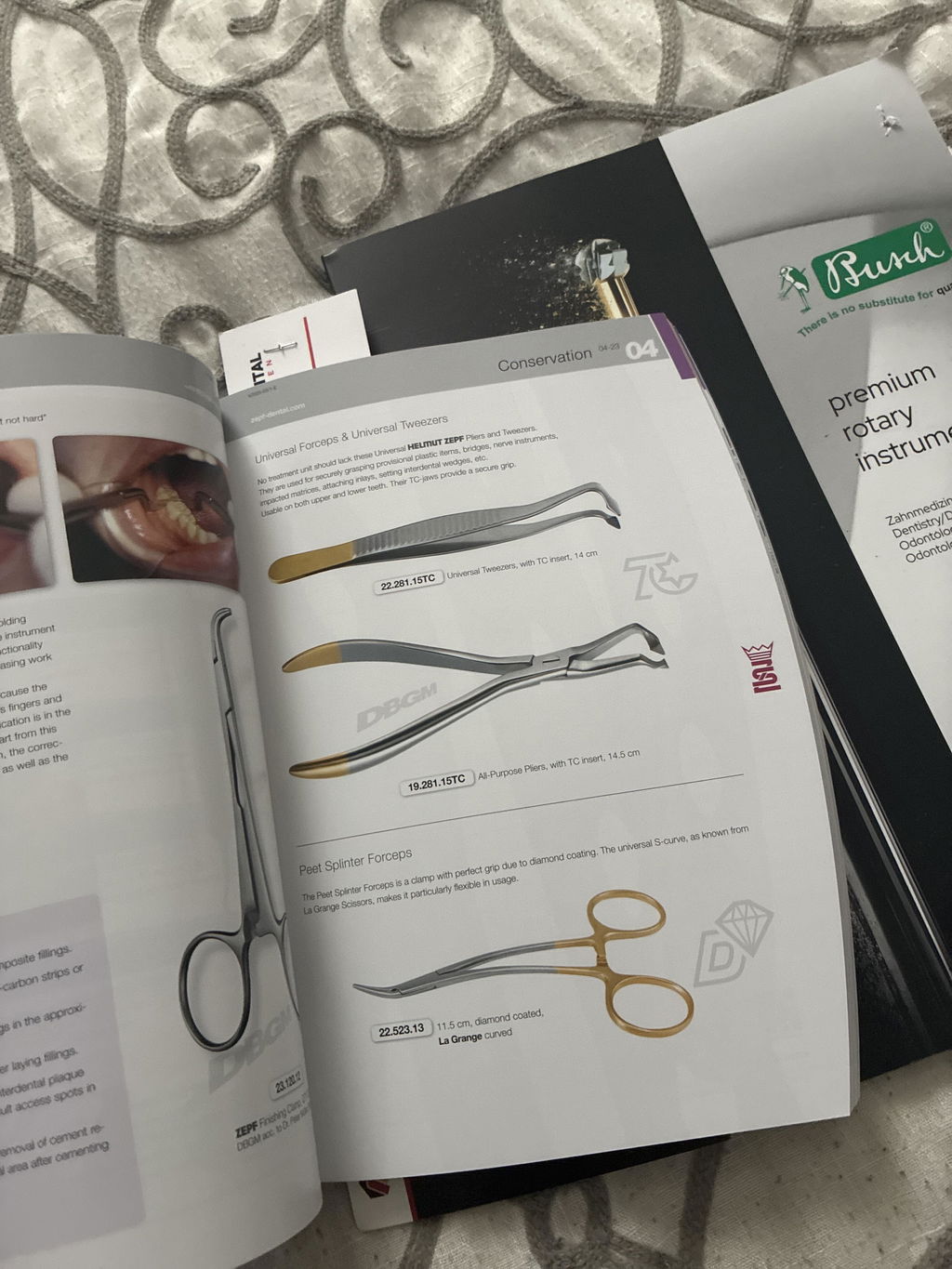
Every instrument on a modern tray is an argument that won. The beak angle of a forceps, the flute geometry of a carbide bur, the taper of an elevator — each detail survived a century or more of clinical trial and error, manufacturer refinement, and competition between designs. Understanding how dental surgical instruments evolved isn't just history for its own sake: it explains why today's patterns look the way they do, why certain numbering systems persist, and why German manufacturing came to define the premium end of the instrument world.
From Extraction by Force to Instruments by Design
For most of dental history, "instrumentation" meant crude leverage. Ancient and medieval tooth-pullers used pliers-like tools, keys, and pelicans that gripped whatever they could reach — usually the crown — and removed teeth with as much bone and soft tissue as came along. The transformation began in the 18th and 19th centuries, when anatomy-driven design replaced brute force: instrument makers began shaping beaks to fit specific teeth, matching handle geometry to the arch being treated, and building families of related patterns rather than single all-purpose tools.
By the late 19th century this produced the standardized pattern systems clinicians still order by number today. The American-pattern forceps family assigned numbers to anatomical designs — the #150 upper universal, its lower counterpart the #151, and specialized designs like the #23 cowhorn, whose furcation-engaging beaks solved the specific mechanical problem of bifurcated lower molar roots. The same era's operative dentistry, shaped by G.V. Black's principles of cavity preparation, standardized rotary instruments into the US numbering tradition that gave us designations like the #330 pear bur — numbers so embedded in clinical training that they remain the everyday language of American operatories more than a century later.
Shop Oral Surgery Instrument Collection
View all-

Helmut Zepf GmbH
Micro Friedman Rongeur Forceps - Slightly Curved, 15.5 cm | Helmut Zepf No. 42.315.16
Regular price $269.99Unit price -
Helmut Zepf GmbH
Regular price $109.99Unit price -
Helmut Zepf GmbH
Regular price $109.99Unit price


The German Manufacturing Heritage
The instrument-making corridor of southern Germany — Tuttlingen and its surrounding towns — became the world's center of surgical instrument manufacturing in this same period, and two companies from that tradition define our catalog.
Busch & Co., 1905. When brothers Ernst and Otto Busch founded their dental bur factory in Düsseldorf, Germany had roughly 500 dentists in the entire country. Their intention was to accelerate the fledgling profession by building better rotary instruments — and the company that moved to Engelskirchen in 1908 would eventually be described, a century later, by a single statistic: one billion burs. That production history, spanning every technological shift in rotary dentistry, lives on in the Busch rotary instrument collection.
Helmut Zepf Medizintechnik, 1921. Isidor Zepf's young workshop in Seitingen-Oberflacht earned its reputation through an extraordinary early collaboration: the famous surgeon Professor Ferdinand Sauerbruch turned to Zepf to realize his surgical instrument designs and prosthetic prototypes. Isidor and his daughter Rosa — likely among the first female surgical instrument makers — built those instruments to the professor's exacting specifications, establishing the clinician-collaboration model the company still follows today, now in its fourth generation. The full breadth of that surgical heritage is represented in the Helmut Zepf instrument collection, and the complete story is on our About Us page.
The Carbide Revolution
Mid-20th-century materials science transformed rotary instruments more than any development since the powered handpiece. Tungsten carbide — dramatically harder than the steel it replaced — allowed blade geometries that cut tooth structure, amalgam, and metal alloys with speed and precision steel burs could never achieve, and held their edges through repeated use. Paired with the high-speed air turbine in the 1950s, carbide instruments redefined what a single appointment could accomplish. Today's Dental Carbide Bur collection represents the mature form of that revolution: finest-grain tungsten carbide, precision-ground flutes, and cut designs specialized for everything from cavity preparation to surgical bone cutting.
Diamond Instruments and the Age of Esthetics
As restorative dentistry shifted toward crowns, veneers, and eventually all-ceramic restorations, a parallel instrument family matured: bonded-diamond abrasives capable of shaping enamel, porcelain, and — in the modern era — zirconia. The Dental Diamond Bur collection traces this lineage from classic crown-preparation designs through contemporary innovations like the COOL DIAMANT line, whose bonding structure improves coolant flow at the cutting surface, and the ZIRAMANT collection, engineered specifically for the zirconia restorations that earlier generations of diamonds wore out against. The division of labor between the two rotary families — blades for shearing, grit for grinding — is the subject of our Carbide vs. Diamond Burs clinical selection guide.
Standardization and the Science of Reprocessing
Two quieter revolutions ran alongside the visible ones. International standardization gave every rotary instrument a systematic identity — the ISO numbering system that encodes material, shank, shape, cut, and size in five three-digit blocks, making instruments identifiable across every manufacturer and market. And infection control transformed from ritual to science: validated cleaning chemistry, ultrasonic and thermal washer-disinfection, steam sterilization protocols, and purpose-built carriers like ZEPFcare sterilization cassettes and STERI-SAFE bur blocks that protect instruments through the reprocessing cycle. Our guide on how to sterilize rotary instruments covers the modern workflow in detail — a document that would have read as science fiction to a 19th-century operator.
The Modern Era: Implantology and Microsurgery
The implant era demanded a new generation of instruments — and reversed a historical priority. Where early exodontia optimized for removal at any cost, modern extraction optimizes for what remains: periotomes, atraumatic forceps systems like Zepf's Xcision-Line, and the Benex vertical extraction system all preserve the bone and soft tissue that implant placement depends on. Alongside them, complete surgical ecosystems evolved — the implantology instrument collection spans bone expansion, sinus lift, augmentation, and grafting instrumentation, detailed in our Helmut Zepf implantology instrument guide — while periodontal microsurgery instruments brought ophthalmic-grade precision to soft tissue work that earlier generations managed with standard-scale tools.
What History Teaches About Choosing Instruments
Three lessons run through this entire evolution. First, anatomy wins: the patterns that survived — the #150's conical beaks, the cowhorn's furcation horns, the pear bur's rounded internal angles — are the ones that fit biological reality rather than fighting it. Second, materials matter as much as design: carbide and bonded diamond didn't refine existing instruments, they redefined what instruments could do. And third, manufacturing quality is the difference between a pattern and a performance: the same #150 design cut from premium steel with precise beak geometry behaves differently at the chair than a bargain forging, which is why the German manufacturing tradition — now well past a century old at both Busch and Zepf — still commands the confidence of clinicians worldwide.
Explore the full catalog at Deutsche Dental Technologien, from rotary instruments to complete surgical systems, or call our team at (917) 480-2682 — we're happy to talk instruments, historic or otherwise.
Related resources: Product Library · Helmut Zepf Literature · Busch Catalogs