Frenectomy Instruments: Scalpels, Hemostats and Scissors for a Clean Release

- Four rolesretract to expose, incise or excise, clamp bleeders, and stabilize wound edges for suturing
- Lingual exposurethe Wieder Tongue Depressor and Retractor, Small, holds the tongue and shows the floor of the mouth
- IncisionDrop-Control scalpel handle with one-hand blade ejection, or curved Goldman Fox Supercut scissors
- HemostasisHalstead-Mosquito forceps clamp the frenal base and small bleeders
- Pediatric casessame roles, with smaller-profile retractors and finer scissors for the smaller field
Frenectomy instruments determine how cleanly a lip-tie or tongue-tie release is performed, from the first incision to the final suture. Selecting the right scalpel, hemostat, retractor, and scissors keeps the surgical field visible and bleeding controlled throughout the procedure.
Quick answer: A frenectomy tray needs four instruments: a retractor to expose the frenum, a scalpel handle or curved scissors to release it, a small hemostatic forceps such as a Halstead-Mosquito to clamp bleeders at its base, and toothed tissue forceps to steady the wound edges for suturing. DeutscheDT.com carries these patterns from Helmut Zepf, which has been making instruments in Germany since 1921.
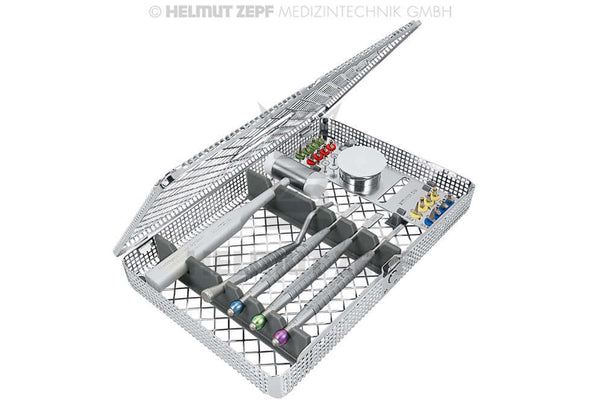
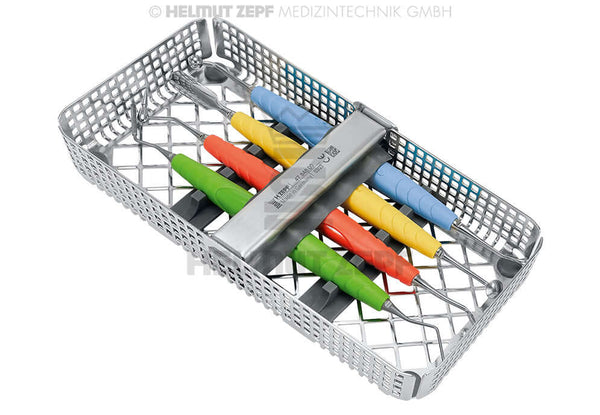
Most general dentists and oral surgeons build a dedicated frenectomy tray from a broader oral surgery instrument collection, pairing a fine scalpel blade handle with atraumatic tissue forceps, a hemostatic clamp, and dedicated scissors for the excision itself.
This guide walks through each instrument role on the frenectomy tray — retraction and exposure, incision, hemostasis, and tissue management — with the specific patterns clinicians reach for most often.
What Instruments Are Used for a Frenectomy?
Four: a retractor to expose the frenum, a scalpel handle or curved scissors to release it, a small hemostatic forceps to clamp bleeders at its base, and toothed tissue forceps to steady the wound edges for suturing.
A frenectomy tray is smaller than a full oral surgery setup, but every instrument still has a defined job. Retraction instruments hold the lip or tongue out of the field so the frenal attachment is fully visible. A scalpel or excision scissors then separates the fibrous band from the underlying tissue.
Hemostatic forceps clamp any bleeding vessels at the base of the frenum, and fine tissue forceps stabilize the wound edges for suturing. Building the tray around these four roles — rather than around brand names — makes it easier to standardize instrument selection for lingual, labial, and buccal frenectomies alike.
Retraction and Exposure
Clear exposure is what separates a controlled release from a ragged one, especially in a mobile, well-vascularized structure like the tongue. A broad, angled blade that depresses the tongue while retracting the floor of the mouth gives the clinician an unobstructed view of the lingual frenum before any incision is made.
Best for: exposing and stabilizing the tongue during a lingual frenectomy — the Wieder Tongue Depressor and Retractor, Small, the small (#1) size of the pattern. Tongue, chin and sweetheart retractor patterns are compared in our tongue and chin retractors guide.
Incision, Hemostasis and Excision
Once the frenum is exposed, the incision itself is typically made with a fine scalpel blade handle or completed with sharp, curved scissors, depending on operator preference and the thickness of the band.
A Drop-Control Scalpel Blade Handle with one-hand blade ejection is a practical choice for tight intraoral access, since blades can be changed without a second instrument; handle patterns and blade choice are covered in our scalpel handles guide and #15 vs #15C vs #12 blade comparison.
Before or during excision, a hemostatic forceps controls bleeding at the base of the frenum. Best for: clamping and controlling bleeders at the frenal base — Halstead-Mosquito Hemostatic Forceps, Straight, Serrated (how it compares with Kelly and Crile patterns is in Kelly vs Halsted-Mosquito vs Crile Hemostats).
For the excision itself, curved scissors with a micro-serrated edge give a clean cut through fibrous tissue without excessive tearing. Best for: completing a clean, controlled excision of the frenal band — Goldman Fox Scissors, Curved, Supercut; other suitable patterns are in our Dental & Surgical Scissor Selection Guide.
Throughout the procedure, a fine tissue forceps such as the Tissue Forceps, 1 x 2 Teeth holds the wound edges steady for both excision and suturing.
| Pattern / Type | Key Trait | Best For |
|---|---|---|
| Drop-Control Scalpel Blade Handle | One-hand blade ejection, Ø12 mm round handle | Precise, controlled frenal incisions |
| Wieder Tongue Depressor and Retractor | Broad blade depresses and retracts in one motion | Exposure of the lingual frenum |
| Halstead-Mosquito Hemostatic Forceps | Fine serrated jaws, straight tip | Clamping the frenal band and controlling bleeders |
| Goldman Fox Scissors, Curved, Supercut | Micro-serrated Supercut edge | Clean excision of fibrous frenal tissue |
FAQs
What instruments are needed for a frenectomy?
A typical tray includes a retractor to expose the frenum, a scalpel handle or scissors to perform the incision or excision, hemostatic forceps to control bleeding, and tissue forceps to stabilize the wound edges for suturing.
Scalpel or scissors — which is better for a frenectomy?
Both are standard; the choice is largely operator preference. A scalpel gives a straight, single-pass incision, while curved Supercut scissors allow the clinician to follow the natural curve of the frenal band during excision.
Why use a tongue retractor during a lingual frenectomy?
A dedicated tongue depressor and retractor holds the tongue out of the surgical field and keeps the floor of the mouth visible, which reduces the risk of an incomplete or asymmetric release.
What forceps are used to control bleeding during a frenectomy?
Small hemostatic forceps, such as a Halstead-Mosquito pattern, are used to clamp the frenal base and any small bleeding vessels before or during excision.
Are frenectomy instruments different for infants versus adults?
The instrument roles are the same, but clinicians often select smaller-profile retractors and finer scissors for infant and pediatric procedures to match the smaller surgical field.
How should frenectomy instruments be sterilized?
Reusable stainless steel scalpel handles, forceps, retractors, and scissors should be cleaned and steam-sterilized (autoclaved) according to the manufacturer's instructions and standard infection-control protocols between every patient use.