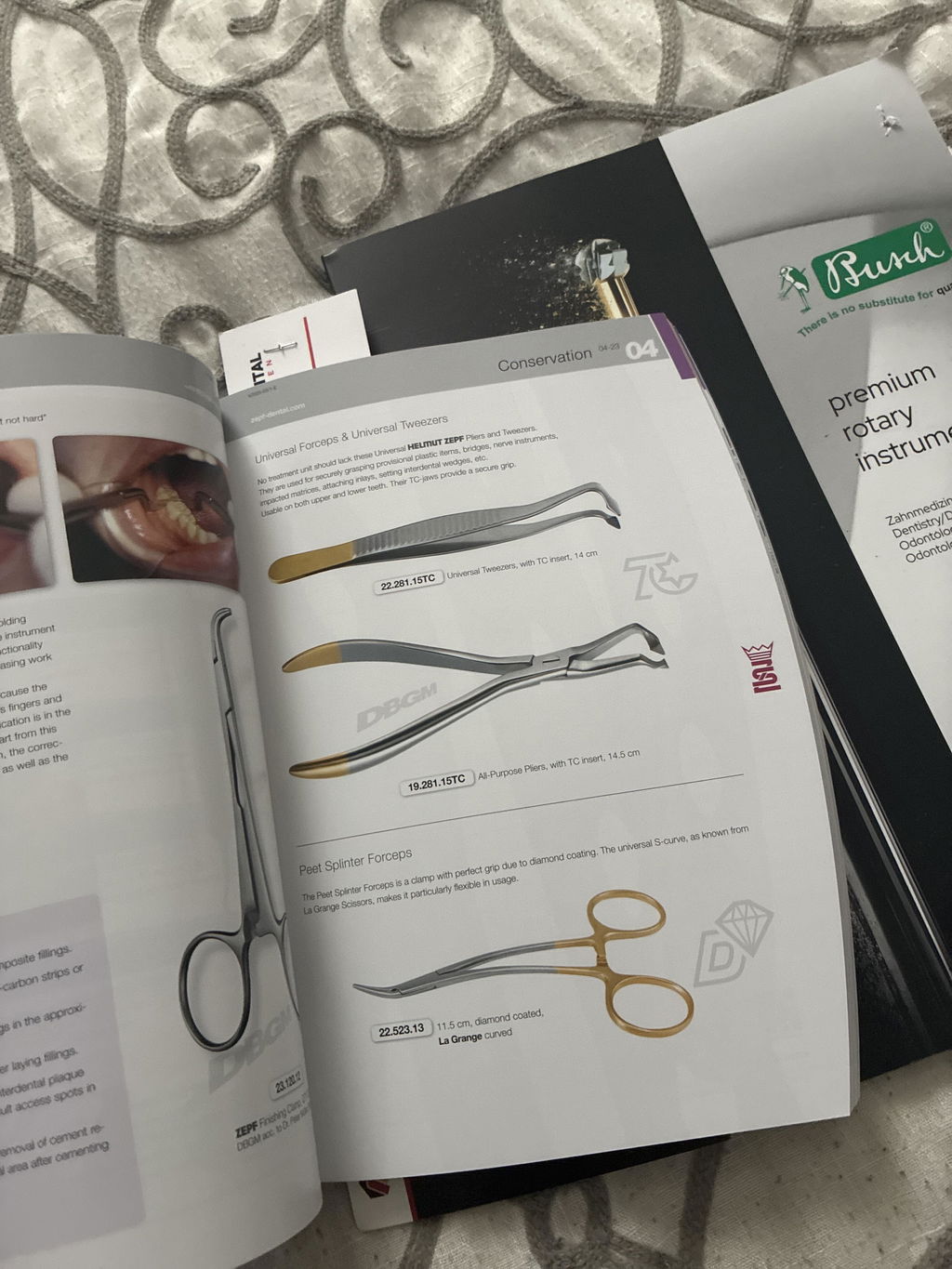
A reliable sickle scaler is still the fastest way to break up supragingival calculus before an ultrasonic tip ever touches the tooth. Zepf's Sickle Scaler Collection spans both anterior and posterior geometries, so matching pattern to surface is really a matter of knowing what each blade was built to do.
Revised on October 1, 2026
Two patterns dominate most operatories: the H6/H7 for anterior and premolar access, and the 204S for tight posterior interproximal contacts. Each does a job the other can't, and neither fully replaces a general-purpose hand scaler.
Shop Sickle Scaler Collection
View all-

Helmut Zepf GmbH
Regular price $47.99Unit price -
Helmut Zepf GmbH
Regular price $47.99Unit price -
Helmut Zepf GmbH
Regular price $45.99Unit price


For clinicians who rotate between several patterns in one appointment, an interchangeable M5 insert handle can also trim tray clutter without sacrificing the tactile feedback a solid instrument gives you.
What Is a Dental Scaler?
A dental scaler is a hand instrument with a pointed tip and two sharp cutting edges, used to remove hardened calculus, plaque, and stain from enamel and root surfaces above and along the gumline before root planing begins. The sickle scaler, with its triangular cross-section, is the most common type.
How to Use a Sickle Scaler: Insertion and Working Angle
Work with a modified pen grasp and a stable fulcrum on an adjacent tooth. Insert the tip at close to 0 degrees against the tooth surface, just beneath the deposit, to avoid soft-tissue trauma. Then rotate the working end to a cutting angle of roughly 45 to 90 degrees against the deposit and activate a short, controlled stroke. Strokes are usually vertical or oblique and directed coronally, away from the gingival margin, so the calculus shears cleanly off the enamel instead of being burnished into it. Use short, overlapping strokes.
Anterior vs. Posterior Sickle Scalers: Matching Pattern to Position
The core distinction between an anterior sickle scaler and a posterior sickle scaler comes down to shank geometry. Anterior patterns use a straighter, single-angled shank so the pointed, double cutting-edge blade can adapt cleanly to the facial and lingual surfaces of incisors, canines, and premolars. Posterior patterns add a second or third bend to the shank, which is what lets the working end reach around the buccal object and into molar embrasures without the clinician having to fight the shank against the arch.
Trying to use one pattern for both jobs is where most fit problems start — an anterior blade forced into a molar interproximal space usually means an awkward wrist angle and burnished, not removed, calculus. Best for: anterior sextants and premolar line angles — the Sickle Scaler #H 6/7, Very Fine covers this zone with opposed tips on a single double-ended instrument.
The H6/H7 Pattern: The Anterior and Premolar Standard
The H6/H7 is arguably the most recognizable hand scaler pattern in a hygiene setup. Its opposed, mirror-image tips mean one working end handles mesial surfaces and the other handles distal, so you're not constantly repositioning or reaching for a second instrument mid-quadrant. The blade's sharp point and moderate bevel angle make it efficient on supragingival ledges and stain along the anterior gumline, though — like any sickle — it should stay coronal to the gingival margin to avoid soft-tissue trauma. The Very Fine version thins the tip further, which is useful for tight anterior contacts and patients with minimal recession where a standard tip feels bulky.
The 204S Pattern: Reaching Posterior Interproximal Contacts
The 204S was designed specifically for the problem anterior patterns can't solve: plaque and calculus packed into interdental spaces in the molar region. Its more acutely angled shank orients the cutting edge so it engages the tooth surface just apical to the contact point, rather than skating across it. Best for: posterior interproximal calculus and line angles the H6/H7 can't reach comfortably — the Sickle Scaler #204 S is the pattern most hygienists reach for once they've cleared the anterior sextants.
More Sickle Patterns: #6/7, T 2-3 and M 23 A
The H6/H7 and 204S cover most trays, but three more Zepf patterns solve specific access problems:
- General anterior and premolar scaling, including tight embrasures: the Sickle Scaler #6/7, Delicate Model (24.205.06HF) has a fine tip that adapts to line angles without over-contouring proximal surfaces.
- Anterior interproximal calculus and stain, especially on rotated or crowded incisors: the steeper blade angulation of the Taylor Sickle Scaler #T 2-3 (24.208.02T) keeps the edge engaged on curved facial and lingual surfaces.
- Interdental plaque and calculus in the molar area, upper and lower: the Posterior Sickle Scaler #M 23 A (24.208.23A) is shaped specifically for this region.
Jacquette Scalers: H5/33 and the Jacquette Pattern
The Jacquette is the straight-bladed sickle: a flat, triangular blade with two cutting edges and a pointed tip, set on a straight or lightly angled shank, so it adapts to anterior facial and lingual surfaces and proximal line angles with a simple pull stroke. Zepf pairs it with an H5 sickle on the double-ended Towner Jacquette Scaler #H5/33 (24.565.33), on a hollow stainless-steel handle for lighter weight and balance; the two ends give you two blade geometries for supragingival calculus without an instrument change. It cross-references to the SH5/33 designation of other brands and has its own Jacquette 5/33 collection. Montana Jack and Nevi are two other sickle patterns you may know from US catalogs; neither is in the Zepf range, and the H6/H7 (anterior) and 204S or M 23 A (posterior) are the closest Zepf patterns for the same surfaces.
Interchangeable M5 Inserts: One Handle, Multiple Working Ends
If your setup tray already carries an H6/H7, a 204S, and a couple of Gracey curettes, an interchangeable-insert system can consolidate sterilization and reduce the number of full instruments you're stocking and resharpening separately. Zepf's M5 insert platform pairs a single ergonomic Z-SHAPE Relax handle with swappable working ends, so the pattern changes but the grip — and the muscle memory built around it — stays constant chairside. Best for: practices standardizing instrument feel across multiple sickle and curette patterns — the Sickle Scaler #204 S, M5 Interchangeable Insert is a straightforward way to trial the system on your highest-use pattern first.
| Pattern | Shank Type | Primary Use |
|---|---|---|
| H6/H7 | Straight, single-angled | Anterior and premolar facial/lingual surfaces |
| 204S | Contra-angled | Posterior interproximal and molar embrasures |
| Jacquette H5/33 | Straight sickle blades, double-ended | Anterior supragingival calculus with two blade geometries on one handle |
| 204S, M5 Insert | Contra-angled, swappable | Posterior interproximal, multi-pattern trays |
FAQs
What's the real difference between an anterior sickle scaler and a posterior sickle scaler?
Shank geometry. Anterior patterns like the H6/H7 use a straighter shank for facial and lingual access on incisors, canines, and premolars, while posterior patterns like the 204S add extra shank angulation to reach around the arch and into molar interproximal spaces.
Is a sickle scaler safe to use subgingivally?
No — the pointed tip and sharp back are designed for supragingival calculus and ledges. For subgingival deposits, a curette with a rounded toe and back is the safer choice to avoid soft-tissue trauma.
What is a hand scaler used for if I already have an ultrasonic unit?
A hand scaler like a sickle removes tenacious supragingival ledges and burnished deposits that ultrasonic tips can glaze over, and it gives tactile feedback an ultrasonic tip can't — many clinicians hand-scale first, then finish with ultrasonics or vice versa depending on deposit density.
How is a chisel scaler different from a sickle scaler?
A chisel scaler is pushed from the facial surface to shear interproximal calculus off adjacent anterior teeth where a sickle can't get proper access, typically in tight mandibular anterior contacts. It's a complementary instrument, not a replacement for a sickle in routine scaling.
How often should sickle scalers be sharpened?
Test the edge before every procedure rather than sharpening on a fixed schedule. A sickle that's burnishing calculus instead of shaving it off needs attention, and frequent light honing extends the life of the blade far better than infrequent heavy grinding.
Are interchangeable M5 inserts as durable as a fixed sickle scaler?
Yes — the working ends are manufactured to the same stainless specifications as Zepf's fixed-handle patterns. The tradeoff is upfront cost for the handle system, offset over time by not having to replace a full instrument every time one pattern dulls faster than another.
Shop the full Sickle Scaler Collection.