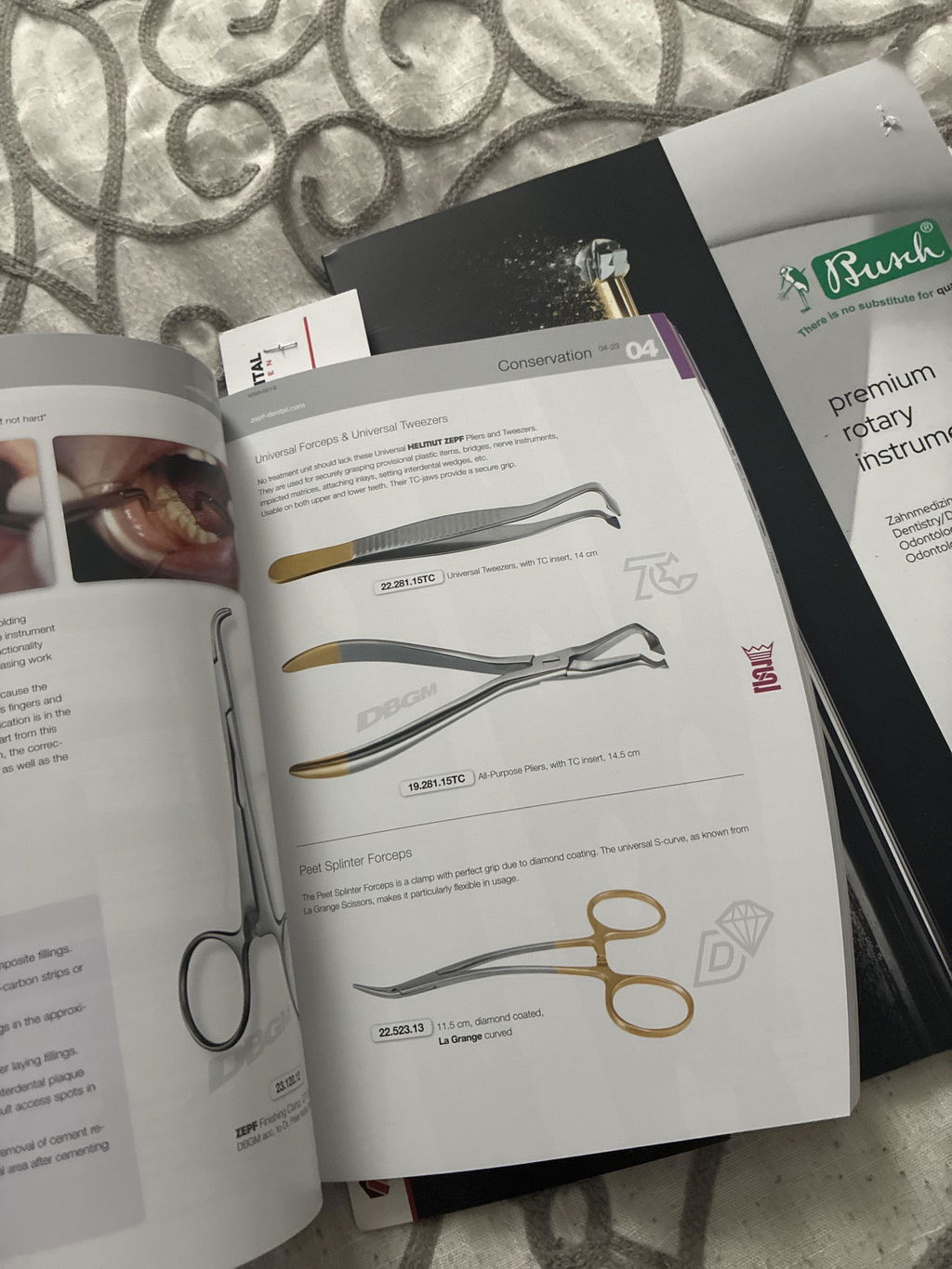
Cat Tooth Extraction: Instruments for Feline Extractions

A cat tooth extraction uses the same steps as a dog extraction, but on roots that are thinner, shorter and far more brittle, so the instruments have to shrink with them. In practice that means luxator blades around 2.5 mm or narrower, mini-handled root tip elevators of 1.5 to 2.5 mm, 699 or 701 crosscut burs for sectioning, small-breed forceps, and fine suturing instruments. Just as important, every feline extraction starts with a dental radiograph, because tooth resorption changes the plan for many teeth. This guide covers feline root anatomy, the instruments sized for cats, and how they fit a cat dental extraction.
Why is cat tooth extraction different from a dog extraction?
Three things set cats apart. First, the roots are small and fragile, and they fracture easily under lever force. Second, tooth resorption is common in cats, and a resorbing root can be partly replaced by bone, so it may not luxate at all. Third, the mandible is thin, especially around the canine and the first molar, so heavy elevation risks a jaw fracture. The answer to all three is the same: narrow, sharp instruments, sectioning before elevation, and patience instead of force.
Radiographs come first
The 2019 AAHA Dental Care Guidelines for Dogs and Cats strongly recommend full-mouth intraoral radiographs for all dental patients and call pre- and post-extraction radiographs essential. AAHA also notes that clinically important findings turn up in a large share of feline teeth that look normal on the oral exam. In cats, the preoperative image does one more job: it shows whether a resorbing tooth still has a periodontal ligament space and canal, which decides whether the root must be extracted whole. Published veterinary dental guidance describes crown amputation with intentional root retention only for specific, radiographically confirmed resorption patterns with no ligament space, no canal, no periapical lesion and no periodontal disease. That is a case-by-case clinical judgment, and it is not an option in cats with stomatitis, where all root material should be removed. Our guide to feline tooth resorption covers that decision in detail.
Feline root anatomy at a glance
An adult cat has 30 teeth. Incisors and canines have one root each. The maxillary third premolar has two roots, the maxillary fourth premolar (108/208) has three, and the small maxillary second premolar and first molar often have one root or fused roots. In the mandible, the third and fourth premolars and the first molar (309/409) each have two roots. Every tooth with two or more separate roots should be sectioned before elevation.
| Cat | Dog | |
|---|---|---|
| Adult teeth | 30 | 42 |
| Typical luxator blade | 2.5 mm and narrower | 2.5 to 4.0 mm |
| Root tip pick | 1.5 to 2.5 mm mini handle | 2.0 to 2.5 mm standard handle |
| Sectioning bur | 699 (0.9 mm) or 701 (1.2 mm) | 701 (1.2 mm) or 702 (1.6 mm) |
| Bone removal bur | #1 (0.8 mm) or #2 (1.0 mm) round | #2 (1.0 mm) or #4 (1.4 mm) round |
| Forceps | Small-breed / deciduous pattern | Small root forceps to standard patterns |
| Special risks | Resorption, ankylosis, mandibular fracture | Long canine roots, oronasal fistula |
Instruments for feline extractions
Luxators and root tip elevators
The working blade should follow the curve of a narrow feline root. The X-Luxa-Tool-1, straight, 2.5 mm (17.007.01) and the X-Luxa-Tool-3, curved, 2.5 mm (17.007.03) cover most feline teeth. For the smallest roots and for tip retrieval, the Heidbrink mini-handle series gives finer control: #1 straight, 1.5 mm (17.051.01), #2 curved, 2.0 mm (17.051.02) and #3 curved, 2.5 mm (17.051.03). When a root needs controlled rotation, the Root Elevator 2 mm, #0 (17.001.10) is the narrowest standard elevator. Remember that a luxator cuts ligament and is not a lever; we cover the distinction in Periotome vs Luxator vs Elevator.
Burs sized for cats
Busch numbers carry the ISO size, so dividing the last three digits by ten gives the head diameter in millimeters. For sectioning, the US 699 (Busch 33 009), 0.9 mm and the US 701 (Busch 33 012), 1.2 mm crosscut tapered fissure burs keep the cut narrow. For bone windows, the US #1 round (1 008 FG), 0.8 mm and US #2 round (1 010 FG), 1.0 mm remove bone in small, controlled amounts. To smooth the alveolar margin, a fine diamond such as the 8379 018 football (egg), fine grit, red ring leaves a smooth surface. Busch has made rotary instruments in Engelskirchen, Germany since 1905. More sizes are in the feline dental bur collection; speeds are on the dental bur speed chart.
Forceps, periosteal elevators and closure
Feline roots are delivered with the lightest forceps that will hold them. The Hull #101 deciduous forceps (14.101.00) suits cat teeth and small-breed dogs. Flaps are raised with a small periosteal elevator such as the Molt #2, 4.0 / 2.5 mm (41.862.12). For closure with fine suture, a Derf needle holder, 12 cm (41.240.12) or a Castroviejo needle holder (41.200.15TC) pairs well with micro Adson tissue forceps (22.488.12). Our article on the Castroviejo needle holder explains why it suits fine suture.
Cat dental extraction: the general sequence
The order below describes general accepted practice. It is not a manufacturer instruction and does not replace training or the patient's anesthetic and analgesic plan.
- Radiograph the tooth and decide on extraction, or, only where criteria are met, crown amputation.
- Release the gingival attachment with a fine blade or a 2.5 mm luxator.
- For canines and multirooted teeth, raise a full-thickness flap and remove a small amount of buccal bone with a #1 or #2 round bur.
- Section multirooted teeth through the furcation with a 699 or 701 bur.
- Luxate each root with gentle apical pressure, staying in the ligament space.
- Elevate with small rotations held for several seconds; stop and reassess if the root does not move.
- Deliver with small forceps, smooth the bone with a fine diamond, and close tension-free with fine absorbable suture.
- Take a post-extraction radiograph to confirm that no root remains.
What if a feline root will not move?
A root that does not luxate after the ligament is cut is often ankylosed or resorbing. Forcing it is how roots shatter and mandibles fracture. Take another radiograph. Where the root is still distinct from bone, remove more buccal bone and use a fine pick. Where the root has radiographically been replaced by bone, the treating veterinarian may consider the crown amputation criteria above. Retrieval of tips is covered in our root tip elevator and forceps guide.
Frequently asked questions
What luxator size is best for a cat? Most feline roots take a blade of 2.5 mm or narrower, such as the X-Luxa-Tool-1 or X-Luxa-Tool-3. Fine root tips call for a 1.5 to 2.0 mm Heidbrink mini pick.
Which bur should I use to section cat teeth? A crosscut tapered fissure bur in 699 (0.9 mm) or 701 (1.2 mm) on a water-cooled high-speed handpiece is the common choice.
Do cats need radiographs before every extraction? The AAHA dental guidelines call pre- and post-extraction radiographs essential, and resorption makes the preoperative image especially important in cats.
Can I leave a resorbed root in a cat? Only where the radiographic and clinical criteria for crown amputation are met, and never in a cat with stomatitis. The decision belongs to the treating veterinarian, and referral to a veterinary dentist is appropriate when in doubt.
Can dog extraction instruments be used on cats? Some can, but wider blades and heavier forceps increase the risk of root and jaw fractures. A dedicated feline set with narrow blades is the safer choice.
Building a feline tray
Narrow blades, small burs and light forceps make feline work more predictable. Helmut Zepf has made instruments in Seitingen-Oberflacht, Germany since 1921. Browse the feline extraction collection, the root tip elevators and picks and the suturing instruments, or start at the veterinary dentistry hub on DeutscheDT.com. For the full canine workflow, see our dog tooth extraction guide, and for cats with stomatitis, feline stomatitis and full-mouth extractions.
This article is intended as an educational reference for veterinary professionals and does not replace clinical judgment, specialist training or manufacturer instructions for use.