Dog Tooth Extraction: Instruments and Step-by-Step Technique

A dog tooth extraction is done in a set order: radiograph the tooth, release the gingival attachment, raise a flap where the tooth needs it, section every multirooted tooth into single-rooted pieces, cut the periodontal ligament with a luxating elevator, elevate patiently, deliver the root, then smooth the bone, close without tension and radiograph again. Each of those steps has its own instrument. This guide follows a canine dental extraction from the first radiograph to the last suture, names the instrument for each step, and gives the Helmut Zepf and Busch numbers that fit a canine tray.
Why dog tooth extraction starts with a radiograph
The roots you cannot see decide how the extraction goes. The 2019 AAHA Dental Care Guidelines for Dogs and Cats strongly recommend full-mouth intraoral radiographs for every dental patient and call pre- and post-extraction radiographs essential. The preoperative image shows root number and shape, curvature, ankylosis, resorption, periapical lesions and the bone left around the tooth. The postoperative image confirms that no root tip was left behind. If a practice cannot take intraoral radiographs, AAHA advises telling the client that a complete examination was not possible. Referral to a board-certified veterinary dentist (AVDC) is the right call for cases beyond the clinician's training.
Know the roots before you pick up an instrument
An adult dog has 42 teeth, and the root count drives the technique. Incisors and the canine teeth have one root; the canine root is long, curved and roughly twice the length of the crown. The first premolars and the mandibular third molars have one root. The remaining premolars and the mandibular first and second molars have two roots, and the maxillary fourth premolar (108/208) and the maxillary first and second molars have three. Any tooth with more than one root is sectioned before elevation. Trying to elevate a two-rooted tooth as one unit is a common cause of fractured roots.
Dog dental extraction: step by step
The sequence below describes general accepted practice in veterinary dentistry. It is not a manufacturer instruction, and it does not replace hands-on training, the patient's anesthetic plan or the instructions for use that come with each instrument.
- Radiograph and plan. Confirm root count, shape and pathology, and decide whether the tooth needs a closed or an open (surgical) extraction.
- Release the gingiva. Cut the epithelial attachment around the tooth with a #15 or #15C blade or a thin luxator.
- Raise a flap where needed. Canine teeth, carnassials and other large multirooted teeth are usually extracted open. Releasing incisions are placed at line angles, and a full-thickness mucoperiosteal flap is lifted with a periosteal elevator.
- Remove buccal bone if needed. A round carbide bur on a water-cooled high-speed handpiece removes a measured amount of buccal bone over the roots.
- Section multirooted teeth. A crosscut tapered fissure bur cuts from the furcation through the crown so each root becomes its own segment.
- Luxate. A thin, sharp luxating elevator is worked down the periodontal ligament space on each side of the root to cut the fibers.
- Elevate. A root elevator is seated in the ligament space and rotated, then held for 10 to 15 seconds so the ligament fatigues. Patience matters more than force here.
- Deliver. Small extraction forceps lift out the loosened root with a gentle rotational pull, not a crush.
- Debride and smooth. Remove granulation tissue, lavage, and smooth sharp alveolar margins with a diamond bur or a rongeur.
- Close and confirm. Release the periosteum under the flap so the closure is tension-free, suture with fine absorbable material, and take the post-extraction radiograph.
Instruments for each step of a canine extraction
| Step | Instrument | Suggested options |
|---|---|---|
| Flap elevation | Periosteal elevator | Molt #9, 7.0 / 4.6 mm (41.862.13); Molt #2, 4.0 / 2.5 mm (41.862.12) for small dogs |
| Bone removal | Round carbide bur, FG or FG-XL | Busch 141 010 FG-XL, 1.0 mm; 141 014 FG-XL, 1.4 mm |
| Sectioning | Crosscut tapered fissure bur | US 701 (Busch 33 012), 1.2 mm; US 702 (Busch 33 016), 1.6 mm |
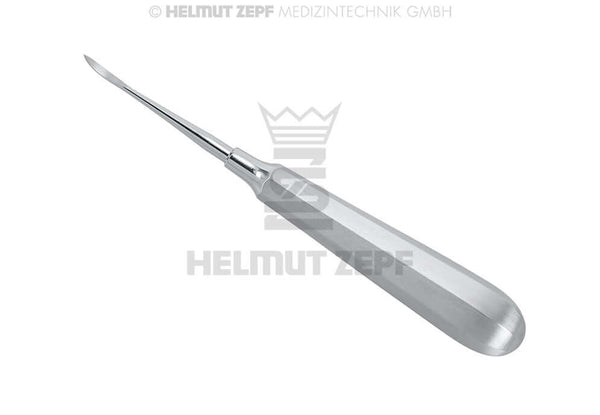
| Ligament cutting | Luxating elevator | X-Luxa-Tool-6, straight, 3.0 mm (17.007.06); X-Luxa-Tool-7, curved, 3.0 mm (17.007.07) |
| Elevation | Root elevator, sized to the root | Root Elevator 3 mm (17.001.11); 4 mm (17.001.12) |
| Delivery | Small extraction or root forceps | Tomes #69 root forceps (14.069.00) |
| Alveoloplasty | Diamond bur or rongeur | Busch 368 016 football (egg) diamond, 1.6 mm; Mini Friedman rongeur, 30° (42.320.14) |
| Closure | Needle holder, tissue forceps, scissors | Mayo-Hegar 14 cm, tungsten carbide (41.258.14TC); Adson 1 x 2 teeth, 15 cm (22.486.15) |
Which burs are used for a dog tooth extraction?
Two bur families do most of the work. Round carbide burs remove bone and open windows over the roots; crosscut tapered fissure burs section the tooth. Busch sizes follow ISO, so the last three digits divided by ten give the head diameter in millimeters: a 33 016 (US 702) is 1.6 mm at the widest point, and a 33 012 (US 701) is 1.2 mm. Large-breed teeth with long crowns are easier with a long-shank bur such as the 702L (33L 016) or the surgical-length 702X (33RL 016 FG-XL). Busch has made rotary instruments in Engelskirchen, Germany since 1905, under ISO 13485. For why crosscut burs cut cleanly in hard tissue, see our article on crosscut carbide cutters; the general carbide-or-diamond decision is covered in the carbide vs diamond guide. The full range is in the veterinary sectioning bur collection and the surgical bur collection.
Luxator or elevator: which goes first in a dog?
The luxator goes first. Its thin, sharp blade cuts the periodontal ligament and is not built to lever; an elevator has a thicker blade made for controlled rotation. We explain the difference in detail in Periotome vs Luxator vs Elevator. For canine patients, the practical rule is to match blade width to root diameter: the blade should follow the curve of the root surface without riding on bone. Narrow roots in toy breeds suit the 2.5 mm X-Luxa-Tool-1 (17.007.01), while a large-breed canine tooth may take the 4.0 mm X-Desmo-Tool (17.007.05) and then a 4 or 5 mm root elevator. The luxating elevator collection lists every blade width.
How to manage a fractured root tip
Root tips break most often in the canine teeth and in the palatal root of the upper fourth premolar. Take a radiograph to locate the fragment. Removing a little more buccal bone and using a fine root tip pick, such as the Heidbrink #1 straight mini (17.051.01), usually brings it out. Retrieval technique is covered in our root tip elevator and forceps guide, and the picks are in the root tip elevator and pick collection. Whether a fragment may be left is a clinical judgment for the treating veterinarian; it should be documented radiographically and discussed with the client.
Common complications to plan for
- Oronasal fistula. The maxillary canine root sits close to the nasal cavity. Gentle elevation and a tension-free flap reduce the risk.
- Mandibular fracture. Small dogs with advanced periodontal bone loss around the mandibular first molar or canine are at risk. Radiographs show how much bone is left before any force is applied.
- Nerve and vessel injury. Keep releasing incisions and bone removal clear of the infraorbital and mental foramina.
- Dehiscence. A flap under tension tends to open. Releasing the periosteum is the usual fix.
Frequently asked questions
What instruments do you need for a dog tooth extraction? At minimum: a scalpel blade, a periosteal elevator, round and crosscut fissure burs on a water-cooled high-speed handpiece, luxating elevators, root elevators in several widths, small extraction or root forceps, a diamond bur or rongeur for alveoloplasty, and a suture kit with a needle holder, tissue forceps and scissors.
Do all dog extractions need a flap? No. Single-rooted incisors and many small premolars can be removed closed. Canine teeth, carnassials and most multirooted teeth in medium and large dogs are usually extracted open.
Which bur size is best for sectioning canine teeth? Many clinicians use a 701 (1.2 mm) for small dogs and a 702 (1.6 mm) for medium and large dogs, choosing a long or surgical-length shank for tall crowns. Bur speeds are listed on our dental bur speed chart.
Should I radiograph after every extraction? The AAHA dental guidelines describe pre- and post-extraction radiographs as essential. The post-extraction image is the only reliable way to confirm no root remains.
How do I keep extraction instruments sharp? Use luxators only for ligament cutting, never as levers, and follow the validated reprocessing instructions. Our surgical instrument reprocessing guide covers cleaning and sterilization, and the sharpening and reconditioning service restores dull blades.
Building a canine extraction tray
A good canine tray has two or three blade widths of each instrument so the blade always fits the root. Helmut Zepf has made instruments in Seitingen-Oberflacht, Germany since 1921, and Busch burs are made in Engelskirchen. Browse the canine extraction collection, the periosteal elevators, rongeurs and bone files and suturing instruments, or start at the veterinary dentistry hub on DeutscheDT.com. For cats, see our companion guide to cat tooth extraction, and for the upper fourth premolar, carnassial tooth extraction.
This article is intended as an educational reference for veterinary professionals and does not replace clinical judgment, specialist training or manufacturer instructions for use.