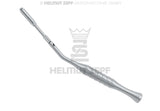
Bone Scraper - Curette Style
The curette-style bone scraper is a double-ended hand instrument — the Buser back action chisel, Helmut Zepf No. 24.495.01, 24.495.02 and 24.495.03 — with 3, 4 and 5 mm working ends for scraping autogenous bone chips. Helmut Zepf makes all three in Germany, and every one on this page ships from our US warehouse.
Read more
It is a versatile, reusable curette-style bone harvester designed for precise and efficient autogenous bone collection in implantology and periodontal surgery.
This classic curette-style bone scraper features a rounded, sharp working end that excels at scraping and harvesting high-quality cortical bone chips with excellent cell viability.
Browse our authentic Helmut Zepf Curette Bone Scrapers and related bone management instruments. Trusted by implantologists and periodontists who demand German engineering excellence.
Deutsche Dental Technologien – Authorized Distributor of Helmut Zepf Premium German Dental Instruments.


Helmut Zepf GmbH
Back Action Chisels, Curette Bone Scraper by Buser 3 mm/5 mm | Helmut Zepf No. 24.495.03
Regular price $149.99Unit price-
Helmut Zepf GmbH
Back Action Chisels, Curette Bone Scraper by Buser 4 mm/5 mm | Helmut Zepf No. 24.495.02
Regular price $149.99Unit price -
Helmut Zepf GmbH
Back Action Chisels, Curette Bone Scraper by Buser 3 mm/4 mm | Helmut Zepf No. 24.495.01
Regular price $149.99Unit price


Reference pages already linked from this collection, in one place.
Which Curette-Style Bone Scraper Do You Need?
All three are the same Buser pattern; choose by the pair of working-end widths.
Buser back action chisels / curette bone scrapers3 items
Features and Applications
Why Choose Zepf Bone Scraper - Curette Style?
- German Precision Engineering – Handcrafted by Helmut Zepf for superior quality and performance
- Curette-Style Design – Double-ended working ends for smooth, controlled bone harvesting
- Sharp Cutting Edge – Efficient collection of vital autogenous bone with minimal effort
- Ergonomic Handle – Excellent balance and reduced hand fatigue
- Three Width Combinations – 3/4 mm, 3/5 mm and 4/5 mm working ends for access to mandible, maxilla, and tuberosity areas
- Fully Reusable & Autoclavable – Premium stainless steel construction for long-term durability
Ideal Applications
- Autogenous bone harvesting for dental implants
- Socket preservation and ridge augmentation
- Sinus lift and guided bone regeneration (GBR) procedures
- Periodontal regenerative surgery and bone defect repair
- Bone contouring and small-volume grafting
Classic Curette-Style Performance
The Bone Scraper - Curette Style offers a familiar feel for clinicians who prefer traditional scraping techniques. Its rounded curette blade allows for clean, effective harvesting while preserving the osteogenic potential of the collected bone chips — still considered the gold standard in regenerative dentistry.
For higher-volume cases, pair it with the ZEPF Bone Scraper II (disposable blade system) or combine with our Castroviejo Needle Holders, dental micro mirrors, and other microsurgical instruments for complete procedural precision.
Clinical Use
The curette-style bone scraper is used for autogenous bone harvesting in implantology and periodontal surgery — socket preservation, ridge augmentation, sinus lift and guided bone regeneration, and small-volume grafting — and, as a back action chisel, for bone contouring and periodontal osseous surgery. The sharp working end scrapes cortical bone into chips that can be collected and packed into the defect.
Care and Reconditioning
Clean, disinfect and sterilize these instruments between patients following the manufacturer’s validated reprocessing instructions and the symbols on each product’s packaging. Our Dental Hand Instrument Reprocessing & Sterilization Guide covers the general workflow for Helmut Zepf instruments. For surgical and implant instruments, see also our Surgical Instrument Reprocessing & Sterilization Guide.
Compare With
ZEPF Bone Scraper · ZEPF Bone Scraper II · Back Action Chisel Dental Instrument by Helmut Zepf · Periodontal Chisels · Surgical Instrument Comparison Chart · Surgical Instrument Glossary

FAQ
How do I choose the right item from this collection?
Every product page details the exact specification, reference number, and application; for cross-brand references and terminology, see our Surgical Instrument Comparison Chart and Surgical Instrument Glossary — and our experts are a call away at (917) 480-2682 ext 101.
How should these instruments be reprocessed?
Follow the manufacturer’s validated reprocessing instructions and the symbols on each product’s packaging; our reprocessing guide covers the general workflow.
Where are these instruments made?
The instruments in this collection are manufactured by Helmut Zepf Medizintechnik in Seitingen-Oberflacht, Germany — precision dental and surgical instruments since 1921 — and ship fast from our US warehouse.
Manufacturer literature: Bone Scraper II flyer (PDF) — more in our Surgical Instrument Library.