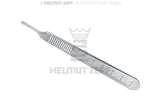
Dental Scalpel Blades
Dental scalpel blades are essential instruments in modern dentistry, engineered to deliver clean, controlled incisions across a wide range of oral and periodontal procedures. Whether applied in routine soft tissue management or complex surgical interventions, these blades provide the sharpness and reliability that clinicians demand at every stage of treatment.


Helmut Zepf GmbH
Scalpel Blades, #15C for Handle No.3, Packing Unit = 100 Pcs, Sterile | Helmut Zepf No. 46.014.15C
Regular price $43.99Unit price-
Helmut Zepf GmbH
Micro Surgical Scalpel Blades #69 Packing Unit = 25 Pieces | Helmut Zepf No. 46.016.09
Regular price $280.99Unit price -
Helmut Zepf GmbH
Micro Surgical Scalpel Blades #67 Packing Unit = 25 Pieces | Helmut Zepf No. 46.016.07
Regular price $148.99Unit price -
Helmut Zepf GmbH
Micro Surgical Scalpel Blades #64 Packing Unit = 25 Pieces | Helmut Zepf No. 46.016.04
Regular price $129.99Unit price -
Helmut Zepf GmbH
Micro Surgical Scalpel Blades #63 Packing Unit = 25 Pieces | Helmut Zepf No. 46.016.03
Regular price $280.99Unit price -
Helmut Zepf GmbH
Scalpel Blades, #15, for Handle No.3, Packing Unit = 100 Pcs, Sterile | Helmut Zepf No. 46.014.15
Regular price $43.99Unit price -
Helmut Zepf GmbH
Scalpel Blades, #12D, for Handle No.3, Packing Unit = 100 Pcs | Helmut Zepf No. 46.014.12D
Regular price $43.99Unit price -
Helmut Zepf GmbH
Scalpel Blades, #12, for Handle No.3, Packing Unit = 100 Pcs | Helmut Zepf No. 46.014.12
Regular price $43.99Unit price -
Helmut Zepf GmbH
Scalpel Blades, #11 for Handle No.3, Packing Unit = 100 Pcs, Sterile | Helmut Zepf No. 46.014.11
Regular price $43.99Unit price -
Helmut Zepf GmbH
Scalpel Blades, #10, for Handle No.3, Packing Unit = 100 Pcs, Sterile | Helmut Zepf No. 46.014.10
Regular price $43.99Unit price


Reference pages already linked from this collection, in one place.
Which Scalpel Blade Do You Need?
Choose the blade shape; every active product in the collection is linked once below by its Helmut Zepf number.
Scalpel blades for handle No. 36 items
| Zepf No. | Pattern or size |
|---|---|
| 46.014.10 | Scalpel blade #10 · for handle No. 3 · 100 pieces · sterile |
| 46.014.11 | Scalpel blade #11 · for handle No. 3 · 100 pieces · sterile |
| 46.014.12 | Scalpel blade #12 · for handle No. 3 · 100 pieces |
| 46.014.12D | Scalpel blade #12D · for handle No. 3 · 100 pieces |
| 46.014.15 | Scalpel blade #15 · for handle No. 3 · 100 pieces · sterile |
| 46.014.15C | Scalpel blade #15C · for handle No. 3 · 100 pieces · sterile |
Micro surgical scalpel blades4 items
Designed for Clinical Excellence
High-quality dental scalpel blades are manufactured from premium-grade stainless steel, ensuring consistent edge retention and sterile performance. Each blade is designed to fit standard scalpel handles, offering a secure and stable grip during delicate intraoral procedures. Their ultra-fine cutting edges minimize trauma to surrounding tissue, supporting faster patient recovery and more predictable surgical outcomes.
A Range of Blade Styles
- No. 12 Blade: Ideal for interproximal incisions and tight posterior access areas.
- No. 15 Blade: The most commonly used blade in periodontal and general oral surgery, offering versatile cutting capability.
- No. 15C Blade: A narrower variant of the No. 15, suited for precise flap elevation and implant site preparation.
- No. 11 Blade: Pointed tip design, commonly chosen for abscess drainage and stab incisions.
Sterility and Safety
Dental scalpel blades are individually packaged and sterilized for single-patient use, meeting stringent infection control standards. Disposable designs eliminate the risk of cross-contamination and reduce instrument reprocessing demands in busy clinical environments, making them an efficient and reliable choice for any practice.
Clinical Use
Scalpel blades make the incisions in oral and periodontal surgery: #15 and #15C for flap and sulcular incisions, #12 and #12D for interproximal and posterior access, #11 for stab incisions and #10 for longer incisions. The micro surgical blades (#63, #64, #67, #69) are for periodontal and other microsurgery.
Care and Reconditioning
Scalpel blades are single-use: fit and remove them with an instrument rather than fingers, and discard used blades in a sharps container. Reusable scalpel handles are reprocessed following the manufacturer instructions; our Surgical Instrument Reprocessing & Sterilization Guide covers the general workflow for Helmut Zepf surgical instruments.
Compare With
Related Helmut Zepf collections: Micro Surgical Scalpel Blades, Scalpel Blade Handle 3D, Scalpel Blade Holder Drop Control, Parallel Scalpel Blade Handle, and Periodontal Microsurgery Instruments. For instrument names and terminology, see the Surgical Instrument Comparison Chart and the Surgical Instrument Glossary.
Part of the Scalpel Handles & Blades hub.

FAQ
What sizes of dental scalpel blades are most commonly used in dentistry?
The No. 15 and No. 15C are the most widely used, though No. 11 and No. 12 blades are also frequently selected depending on the procedure.
Are dental scalpel blades compatible with standard handles?
Yes. The #10, #11, #12, #12D, #15 and #15C blades in this collection are made for handle No. 3, as stated in their product titles.
Are these blades single-use only?
Yes, dental scalpel blades are intended for single-use only to maintain sterility and optimal cutting performance.