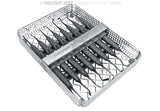
Spatula Shaped Dental Composite Instruments
Spatula Shaped Dental Composite Instruments are essential tools in modern restorative dentistry, designed to give clinicians precise control when placing, shaping, and contouring composite resin materials. Their distinctive blade geometry allows practitioners to adapt material to cavity preparations and proximal surfaces with minimal distortion and maximum efficiency.


Helmut Zepf GmbH
Regular price $77.99Unit price-
Helmut Zepf GmbH
Heidemann Composite Instrument #2 - Rigid/Arched, 3 mm | Helmut Zepf No. 26.262.02
Regular price $19.99Unit price -
Helmut Zepf GmbH
Heidemann Composite Instrument #0 - Rigid/Arched, 2 mm | Helmut Zepf No. 26.262.00
Regular price $19.99Unit price -
Helmut Zepf GmbH
Heidemann Spatula #2 - Flexible, 3 mm | Helmut Zepf No. 26.260.02
Regular price $33.99Unit price -
Helmut Zepf GmbH
Heidemann Spatula #1 - Flexible, 2.5 mm | Helmut Zepf No. 26.260.01
Regular price $33.99Unit price -
Helmut Zepf GmbH
Heidemann Spatula #0 - Flexible, 2 mm | Helmut Zepf No. 26.260.00
Regular price $33.99Unit price -
Helmut Zepf GmbH
Axial Composite Instrument #13 - Spatula 1.6 / 1.6 mm | Helmut Zepf No. 26.200.13
Regular price $35.99Unit price -
Helmut Zepf GmbH
Regular price $77.99Unit price -
Helmut Zepf GmbH
Regular price $77.99Unit price -
Helmut Zepf GmbH
Regular price $77.99Unit price -
Helmut Zepf GmbH
Regular price $104.99Unit price -
Helmut Zepf GmbH
Regular price $77.99Unit price -
Helmut Zepf GmbH
Regular price $77.99Unit price


Reference pages already linked from this collection, in one place.
Which Spatula Shaped Composite Instrument Do You Need?
Choose the handle line first, then the blade width; every instrument in this collection is linked once below by its Zepf number.
ZEPF-bIONIK QuickFix spatulas, Nanopal coating7 items
| Zepf No. | Pattern or size |
|---|---|
| 26.120.10TI | 1.5 mm Small Spatula #1 |
| 26.120.11TI | 2.8 mm Large Spatula #2 |
| 26.120.12TI | 1.8 mm Spatula / 2.6 mm Beavertail Burnisher |
| 26.120.13TI | Micro Composite Instrument 1.1 mm Spatula |
| 26.120.20TI | #1 2.2 mm Spatula / Burnisher Ø 1.5 (pear-shaped) |
| 26.120.21TI | #2 Plugger Spatula 2.4 mm / Burnisher Ø 1.9 mm (pear-shaped) |
| 26.120.50TI | #1 small Spatula combination 1.7 mm Optimal access to the mesial and distal area due to the special bend |
Heidemann spatulas and composite instruments5 items
| Zepf No. | Pattern or size |
|---|---|
| 26.260.00 | Heidemann Spatula #0 - Flexible, 2 mm |
| 26.260.01 | Heidemann Spatula #1 - Flexible, 2.5 mm |
| 26.260.02 | Heidemann Spatula #2 - Flexible, 3 mm |
| 26.262.00 | Heidemann Composite Instrument #0 - Rigid/Arched, 2 mm |
| 26.262.02 | Heidemann Composite Instrument #2 - Rigid/Arched, 3 mm |
Axial composite instrument1 items
| Zepf No. | Pattern or size |
|---|---|
| 26.200.13 | Axial Composite Instrument #13 - Spatula 1.6 / 1.6 mm |
Why Choose Spatula Shaped Dental Composite Instruments?
The spatula profile is one of the most versatile configurations available to restorative clinicians. Spatula Shaped Dental Composite Instruments offer a flat, paddle-like working end that facilitates smooth layering of composite increments, reduces the risk of incorporating air voids, and enables accurate marginal adaptation. Whether working on anterior aesthetics or posterior load-bearing restorations, these instruments provide the tactile feedback and adaptability demanded by expert clinicians.
Key Features
- Ergonomic handles: Designed for a secure, fatigue-free grip during extended procedures.
- ZEPF NANOPAL coating: The ZEPF-bIONIK QuickFix spatulas in this collection carry the NANOPAL coating, which helps keep composite from sticking to the working end.
- Dual-ended designs: Many instruments combine a spatula end with a complementary plugger or condenser tip for multi-step workflow efficiency.
- Autoclave compatibility: Instruments in this category are generally engineered to withstand repeated sterilization cycles without degradation.
Clinical Use
These instruments are suitable for direct composite restorations, layering techniques, and free-hand sculpting of composite veneers or diastema closures. Spatula Shaped Dental Composite Instruments are equally valuable when working with flowable composites, compomers, and glass ionomer materials that require controlled placement.
Care and Reconditioning
Clean, disinfect and sterilize between patients. Our Dental Instrument Reprocessing & Sterilization Guide covers the workflow for Helmut Zepf hand instruments, and our sharpening and reconditioning service reconditions worn instruments when needed.
Compare With
Related Helmut Zepf collections: Heidemann Spatula Composite Instrument, Ball-Shaped Plugger Composite Instruments, Pear-Shaped Plugger Composite Instrument, Condenser Composite Instruments, and Dental Composite Instrument Sets. For patterns and terminology, see the Restorative Instrument Comparison Chart, the Restorative Instrument Glossary and the Dental Composite Instrument Shapes Guide. The comparison chart includes the micro composite spatula designations.
Further reading: 2026 Guide to Dental Composite Instruments: Choosing the Right Tools for Placement
Part of the Composite & Direct Restoration hub.

FAQ
What makes spatula shaped instruments different from other composite placement tools?
Their broad, flat working end allows for smooth material spreading and contouring across wider surface areas, unlike pointed or ball-ended instruments that are better suited to localized placement.
Are these instruments compatible with all composite systems?
Generally, yes. Spatula Shaped Dental Composite Instruments work effectively with light-cured, dual-cured, and self-cured composites available from most major manufacturers.
How should these instruments be maintained?
They should be cleaned, dried, and autoclaved according to the manufacturer's sterilization guidelines after each patient use to ensure longevity and infection control compliance.
Manufacturer literature: Micro-Composite Spatulas flyer (PDF) and the ZEPF Dental Catalog (PDF) — more in our Restorative Instrument Library.