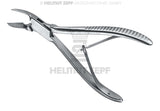
Luer Bone Rongeurs
Luer bone rongeurs are the trusted standard in oral surgery for efficient, controlled removal of larger bone fragments, sharp alveolar edges, and gross tissue refinement. Manufactured by Helmut Zepf GmbH in Germany, these instruments deliver the powerful cutting performance and durability that oral surgeons, periodontists, and implantologists depend on every day.


Helmut Zepf GmbH
Luer Bone Rongeur Forceps - 15 cm | Helmut Zepf No. 42.324.15
Regular price $324.99Unit price-
Helmut Zepf GmbH
Luer Bone Rongeur Forceps #2 - Broad, 15 cm | Helmut Zepf No. 42.328.15
Regular price $367.99Unit price -
Helmut Zepf GmbH
Luer Bone Rongeur Forceps #1 - Narrow, 15 cm | Helmut Zepf No. 42.326.15
Regular price $367.99Unit price


Reference pages already linked from this collection, in one place.
Which Luer Bone Rongeur Do You Need?
All three are 15 cm Luer rongeurs; choose the standard, narrow #1 or broad #2 beak. Every active product in the collection is linked once below by its Zepf number.
Luer bone rongeur forceps, 15 cm3 items
Premium Luer Bone Rongeur Collection
This collection features the most trusted Luer patterns available, each engineered for a specific clinical application:
- Luer Bone Rongeur Forceps, 15 cm — Standard pattern for general bone cutting (No. 42.324.15)
- Luer #1, Narrow — Narrow beaks for more confined sites (No. 42.326.15)
- Luer #2, Broad — Broad beaks for larger bites (No. 42.328.15)
All instruments are crafted from premium surgical stainless steel — fully autoclavable, corrosion-resistant, and built for repeated clinical use without compromise.
Why Choose Zepf Luer Bone Rongeurs?
- Powerful Cutting Efficiency — Strong beaks remove larger bone segments with minimal effort
- Superior Leverage — Ergonomic handles reduce hand fatigue
- Clean Bone Removal — Sharp, precise edges minimize crushing and create smooth alveolar ridges
- Versatile Applications — Ideal for post-extraction alveoloplasty, ridge contouring before implant placement, removal of bony spicules and undercuts, periodontal osseous surgery, and denture ridge preparation
Who Are These Instruments For?
This collection is designed for oral surgeons, periodontists, and implantologists who require reliable, heavy-duty Luer bone rongeurs for efficient bone management. Whether you are performing alveoloplasty, implant site preparation, or periodontal osseous surgery, these instruments provide the control and strength the procedure demands.
History: Who Invented the Luer Bone Rongeur?
The Luer name goes back to Maison Lüer, the Paris surgical instrument house founded in 1837 by Georg Wilhelm Amatus Lüer after he trained under the celebrated French instrument maker Joseph-Frédéric-Benoît Charrière.
Originally focused on ophthalmic instruments, the firm expanded around 1850 into ENT, urology, dentistry, and gynecology, producing forceps, retractors, specula, curettes, and — carrying the family name — bone rongeurs still specified today. (Amatus Lüer's son-in-law, Hermann Wülfing-Lüer, later attached the family name to an entirely different piece of hardware: the Luer-lock syringe fitting.) The double-action, spring-loaded pattern that carries the Luer name remains a standard for controlled removal of alveolar bone in oral surgery.
Shop the standard 15 cm, narrow #1 and broad #2 Luer rongeurs, with fast shipping from our US warehouse, expert support, and competitive pricing on authentic Helmut Zepf instruments. Browse the full collection of Luer bone rongeurs at DeutscheDT.com and experience robust German-engineered bone cutting performance.
Clinical Use
Luer bone rongeurs are used in oral surgery, periodontics and implantology for post-extraction alveoloplasty, ridge contouring before implant placement, removal of bony spicules and undercuts, periodontal osseous surgery and denture ridge preparation; the narrow #1 suits more confined sites and the broad #2 takes larger bites.
Care and Reconditioning
Clean, disinfect and sterilize the rongeurs between patients following the manufacturer instructions and the symbols on each product package, and have the beaks resharpened when they dull through our sharpening and reconditioning service. Our Surgical Instrument Reprocessing & Sterilization Guide covers the general workflow for Helmut Zepf surgical instruments.
Compare With
Related Helmut Zepf collections: Dental Bone Rongeurs & Rongeur Forceps, Mini Friedman Rongeurs, Blumenthal Rongeurs, Cleveland Rongeurs, Böhler Rongeur, and Ruskin Rongeur. For terminology and comparisons, see the Surgical Instrument Comparison Chart and the Surgical Instrument Glossary.

FAQ
How do I choose the right item from this collection?
Every product page details the exact specification, reference number, and application; for cross-brand references and terminology, see our Surgical Instrument Comparison Chart and Instrument Glossary — and our experts are a call away at (917) 480-2682 ext 101.
How should these instruments be reprocessed?
Follow the manufacturer’s validated reprocessing instructions and the symbols on each product’s packaging; our reprocessing guide covers the general workflow.
Where are these instruments made?
The instruments in this collection are manufactured by Helmut Zepf Medizintechnik in Seitingen-Oberflacht, Germany — precision dental and surgical instruments since 1921 — and ship fast from our US warehouse.
Further reading: 2026 Guide to Mini and Micro Friedman Rongeurs: Choosing the Right Instrument