How Podiatrists Remove Corns: Enucleation, Burs and Aftercare

How do podiatrists remove corns? In most cases by enucleation: the overlying hard skin is pared down and the dense central core, or nucleus, is lifted out with a scalpel, then the area is smoothed with a small diamond or carbide bur and the pressure that caused the corn is offloaded.
Quick answer: Podiatrists usually remove corns by enucleation: the overlying hard skin is pared down, the central nucleus is lifted out with a scalpel, the area is smoothed with a small diamond or carbide bur, and the pressure that caused the corn is offloaded. DeutscheDT.com carries corn and callus burs such as the 1SXM carbide round from Busch & Co., for which DeutscheDT is the official US distributor.
Unlike an over-the-counter corn plaster, professional corn removal takes out the nucleus itself, so relief is usually immediate. This guide covers the types of corns, the hand and rotary instruments used for podiatrist corn removal, a general technique, and the aftercare that keeps a corn from coming straight back.
What is a corn, and why does it come back?
A corn (heloma, or clavus) is a small, well-defined area of hyperkeratosis with a central core of compacted keratin that presses into the deeper tissues. It forms where bone presses skin against a shoe or an adjacent toe, so it is a response to concentrated pressure rather than an infection. Calluses form under broader, more diffuse pressure and have no central core. The common types are:
- Hard corn (heloma durum): on the dorsum of the lesser toes, over the joints of a hammertoe or claw toe, or on the tip of the toe.
- Soft corn (heloma molle): between the toes, usually the fourth web space, where moisture keeps the keratin soft and white.
- Seed corns (heloma miliare): small, often multiple lesions on the weight-bearing sole.
- Neurovascular and vascular corns: long-standing corns with nerve or capillary elements in the core. They are painful and bleed easily, so they need extra care.
Because the cause is mechanical, a corn removed without addressing footwear, toe position or gait will usually return. Removal brings relief; offloading prevents recurrence.
How do podiatrists remove corns? The enucleation technique
The steps below describe widely taught general practice, not a manufacturer instruction. Follow your own training and scope of practice.
- Assess. Check circulation, sensation and diabetes status, and confirm that the lesion is a corn rather than a plantar wart, a foreign body or a pressure ulcer under keratin. Pinpoint bleeding and pain on side-to-side squeezing suggest a wart; pain on direct pressure is typical of a corn.
- Debride the surface. Pare the overlying hyperkeratosis with a scalpel (a No. 10 or No. 15 blade is commonly used) until the outline of the nucleus is clear.
- Enucleate the core. Work around the nucleus with the blade tip and lift it out, keeping the angle shallow to avoid cutting viable tissue.
- Refine with a bur. A small round carbide or diamond bur cleans up residual keratin in the base of the lesion and smooths the margins, and is useful where a blade is awkward, such as in the web spaces or on the tip of a toe.
- Reduce the surrounding callus. Bring the surrounding hard skin down to the level of healthy skin with a coarser diamond, then smooth it with a fine grit.
- Offload and advise. Apply padding and explain footwear and skin care before the patient leaves.
Some clinicians use rotary instruments for the whole procedure, especially on fragile or high-risk skin, and the bur is often the gentler option on thin skin over a joint.
Which burs are used for podiatrist corn removal?
Busch identifies two families for corns. The 1SXM carbide round bur has a special power cut with cross-cut and is described by Busch for the gentle removal of clavi and fungal nails, as well as subungual and periungual calluses.
Its slender gold neck gives a clear view of a small working field, and a green ring identifies it. Busch also lists the 801 diamond round for removing clavi. For the surrounding hard skin, Busch DiaTwister and coarse diamonds handle callus reduction, and fine and extra fine diamonds smooth the skin afterward.
| Task | Instrument | Head diameter | Grit or cut |
|---|---|---|---|
| Small corns and the base of the nucleus | 1SXM 010, 1SXM 014 carbide round | 1.0 to 1.4 mm | SXM power cut |
| Larger corns, periungual corns | 1SXM 018 carbide round | 1.8 mm | SXM power cut |
| Corn removal with a diamond | 801 012, 801 018 diamond round | 1.2 to 1.8 mm | Medium (no ring) |
| Soft corns in the web space | 858 014 diamond taper (cone) pointed | 1.4 mm | Medium (no ring) |
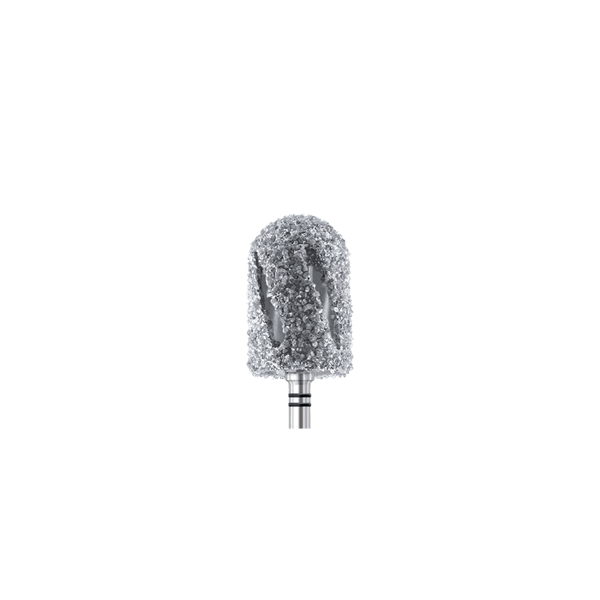
| Surrounding thick callus | DiaTwister DT4880 100 | 10.0 mm | Mega coarse (two black rings) |
| Hard callus around the corn | 5893 050 diamond bud round | 5.0 mm | Super coarse (black ring) |
| Smoothing the skin | 8893 047 bud round, 8854R 033 taper (cone) round | 3.3 to 4.7 mm | Fine (red ring) |
ISO sizes divide by ten for millimeters, so 014 is a 1.4 mm head. Busch diamond grits are color coded: two black rings mega coarse, black super coarse, green coarse, no ring medium, red fine and yellow extra fine. The DiaTwister line has an internal cooling design with slit openings, works in wet or dry technique, and is made in one piece from stainless material for disinfection and sterilization. See every option in the callus and corn removal collection.
Corn removal in high-risk feet
Professional corn removal matters most for patients with diabetes, peripheral arterial disease, neuropathy or anticoagulant therapy, where a small wound can become a serious one. General guidance is that these patients should not use medicated corn plasters or acid-based corn removers, which can macerate skin and cause ulceration, and should not cut corns themselves.
In these feet, many clinicians prefer conservative reduction with fine-grit diamonds and small rotary instruments over deep blade work, and they refer early when there is any sign of ulceration or infection under the keratin.
Aftercare: keeping the corn from coming back
Corn removal relieves pain immediately, but the lesion will return if the pressure stays. Common aftercare in general practice includes:
- Offloading. Aperture pads in felt or foam, silicone toe props or sleeves, and interdigital wedges for soft corns.
- Footwear. A deeper, wider toe box and lower heel; checking that the shoe is not pressing on the site.
- Skin care. A urea-based emollient for the surrounding skin, while keeping the web spaces dry for soft corns.
- Biomechanics. Orthoses where plantar pressure is the cause, and referral for surgical assessment when a fixed toe deformity keeps producing corns.
- Review. Regular reduction at an interval set by the clinician, especially for high-risk patients.
Reprocessing corn burs
Corn burs often touch bleeding or broken skin, so reusable ones must be cleaned, disinfected and sterilized between patients according to the Busch reprocessing instructions. Diamonds clog with keratin; the white 599 cleaning stone is made to remove particles stuck to diamond instruments. Our guide on how to clean nail drill bits covers the whole workflow.
Frequently asked questions
Does podiatrist corn removal hurt? It is usually painless, because the corn is dead keratin. Most patients feel relief straight away, since the nucleus is no longer pressing on the tissue below.
Do podiatrists use a drill to remove corns? Many do, alongside a scalpel. A small round bur such as the Busch 1SXM or an 801 diamond round refines the base of the lesion, and coarser diamonds reduce the surrounding callus.
Why does my patient's corn keep coming back? Corns are caused by pressure. Unless footwear, toe deformity or gait is addressed, the skin will rebuild the corn. Offloading pads, footwear changes and orthoses reduce recurrence.
What is the difference between a corn and a callus? A corn is small and focal with a central core; a callus is broader, more diffuse thickening without a core. Both come from pressure and friction.
Which grit should I use on the skin after corn removal? Finish with a fine (red ring) or extra fine (yellow ring) diamond to leave a smooth surface that is less likely to catch and split.
Corn and callus instruments from Busch
Busch has made rotary instruments in Engelskirchen, Germany since 1905, under ISO 13485. Browse the callus and corn removal collection, the diamond collection for every grit, or the podiatry burs hub for the full range. For bit families in depth, see the Nail Drill Bits Guide for Podiatry.
This article is intended as an educational reference for foot care professionals and does not replace clinical judgment or manufacturer instructions for use.