
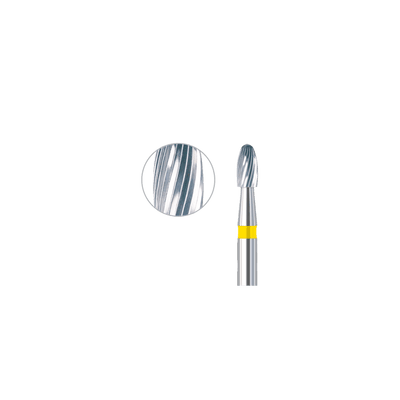
Egg & Football Shaped Finishing Carbide Burs by Busch
Egg (football) finishing carbide burs are the shape of choice for occlusal anatomy: the oval head follows cusp inclines and fossae without flattening them, and the multi-blade carbide cuts composite cleanly rather than grinding it. Busch & Co. makes the 44E series in Germany in three sizes and three blade counts, and each one carries the US number American practices order by.


Busch & Co. GmbH
Regular price $25.99Unit price-
Busch & Co. GmbH
US No. 7408 Busch Carbide Finishing Football (Egg) Bur | Busch No. 44E 023 – RA | Pack of 2
Regular price $24.99Unit price -
Busch & Co. GmbH
Regular price $36.99Unit price -
Busch & Co. GmbH
Regular price $25.99Unit price -
Busch & Co. GmbH
US No. 7408 Busch Carbide Finishing Football (Egg) Bur | Busch No. 44E 023 – FG | Pack of 2
Regular price $24.99Unit price -
Busch & Co. GmbH
US No. 7406 Busch Carbide Finishing Football (Egg) Bur | Busch No. 44E 018 – RA | Pack of 2
Regular price $24.99Unit price -
Busch & Co. GmbH
US No. 7406 Busch Carbide Finishing Football (Egg) Bur | Busch No. 44E 018 – FG | Pack of 2
Regular price $24.99Unit price -
Busch & Co. GmbH
US No. 7404 Busch Carbide Finishing Football (Egg) Bur | Busch No. 44E 014 – RA | Pack of 2
Regular price $24.99Unit price -
Busch & Co. GmbH
US No. 7404 Busch Carbide Finishing Football (Egg) Bur | Busch No. 44E 014 – FG | Pack of 2
Regular price $24.99Unit price


Reference pages already linked from this collection, in one place.
Which Egg Finisher Do You Need?
Pick the shank first, then the head size and blade grade; every active product in the collection is linked once below, and the US number opens all shanks of that bur.
Carbide egg finishing burs, FG (friction grip)5 items
Carbide egg finishing burs, RA (latch)4 items
Sequence
Contour with the standard 12-blade class egg (7404, 7406 or 7408 by size), smooth with the fine 8406, and finish with the ultra-fine 9406 before polishing. Same shape, same size, increasing blade count, so the anatomy you carved in the first pass is preserved through the last.
Made in Germany by Busch & Co.
Busch & Co. has manufactured rotary instruments in Engelskirchen, Germany since 1905. Every instrument on this page is a genuine Busch product, precision-ground on a concentric shank under ISO 13485-certified quality management and covered by our Busch warranty.
Clinical Use
- Occlusal contouring: shaping cusp inclines, marginal ridges and fossae in posterior composite after placement.
- Lingual finishing: refining the concave lingual surfaces of anterior composites, veneers and crowns.
- Amalgam carving and finishing: smoothing occlusal amalgam at the finishing appointment.
- Pre-polish: the F and UF grades leave a surface that two-step diamond polishers bring to a high gloss in seconds.
Care and Reconditioning
Busch carbide finishing burs are reusable: clean, disinfect and sterilize them between patients following the manufacturer instructions, and run them at the recommended speed (see our Dental Bur Speed Chart). Our Dental Bur Reprocessing & Sterilization Guide walks through the workflow for carbide, diamond and steel instruments.
Compare With
Related Busch collections: Composite Finishing Burs, Carbide & Diamond Finishing Burs, Egg & Football Diamond Burs, Football & Egg Burs and Carbide Flame Finishing Burs. For numbering and terminology, see the US Bur Number Finder, the Bur Comparison Chart and the Dental Bur Glossary.
Related: Composite Finishing Burs · Carbide & Diamond Finishing Burs · US Bur Number Finder · Bur Comparison Chart

FAQ
What is the US number for the Busch 44E?
44E 014 is US No. 7404, 44E 018 is US No. 7406 and 44E 023 is US No. 7408. The fine 44E-F 018 is US No. 8406 and the ultra-fine 44E-UF 018 is US No. 9406.
Egg or football, what is the difference?
None. Both names describe the same oval finishing head; US catalogs tend to say egg, European catalogs football.
Which size should I stock?
The 1.8 mm No. 7406 covers most posterior work. Add the 1.4 mm 7404 for premolars and tight anatomy and the 2.3 mm 7408 for large molar restorations.
Carbide or diamond for finishing composite?
Carbide. It cuts rather than grinds, leaves a smoother surface and generates less heat, which is why every bur in this collection is a multi-blade carbide. Diamond eggs belong on enamel and ceramic; see our Egg & Football Diamond Burs.


